Written and edited by the LibraryFit editorial team. Last updated June 2026.
Movement breaks that fit the workday you actually have — not the one fitness advice assumes you have.
Most desk workers don’t fail at movement because nobody told them sitting too long is a problem. They’re trying to fit movement into a workday built around sitting: meetings, screens, deadlines, shared spaces, and clothes that weren’t chosen for exercise.
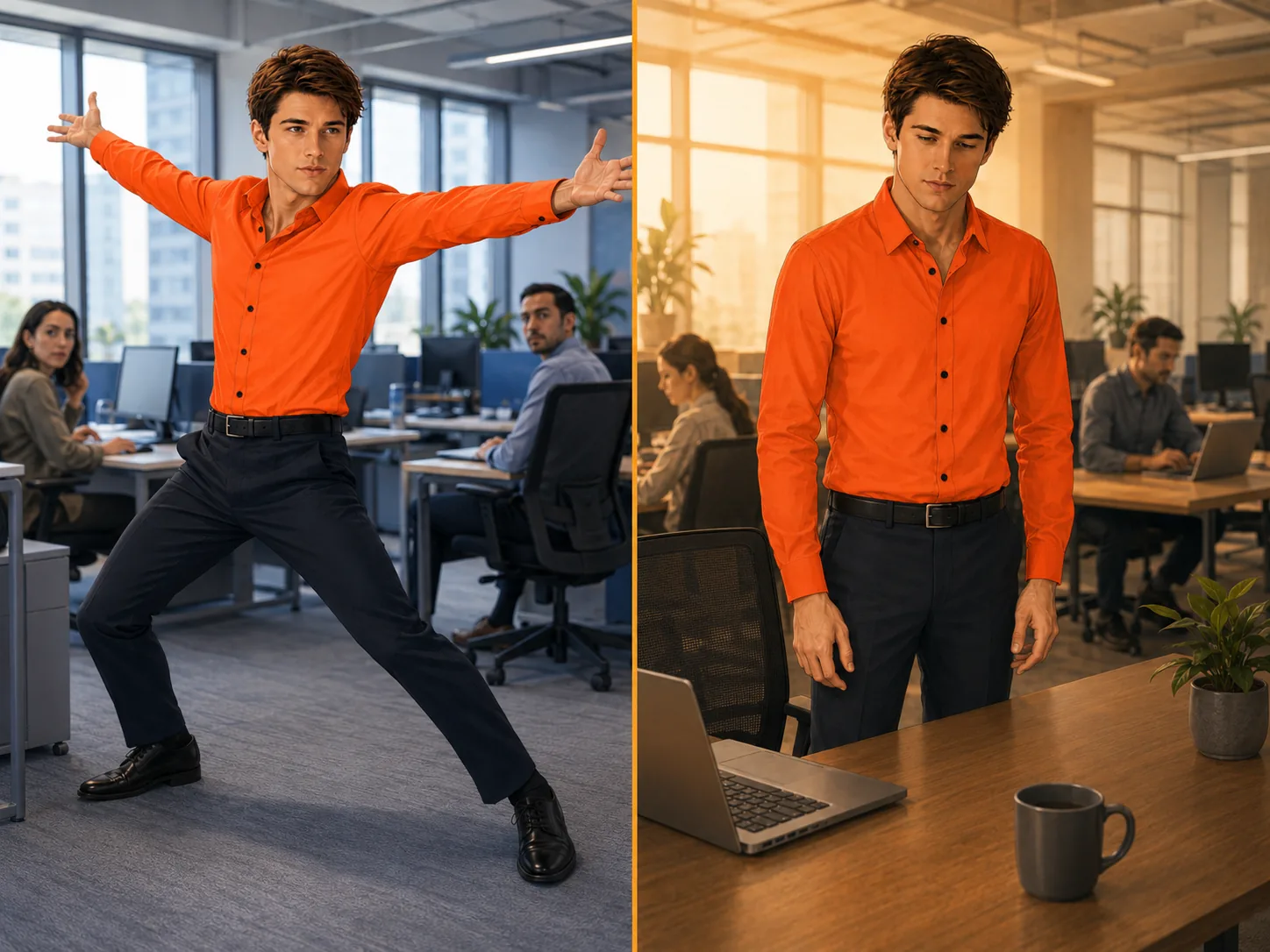
The harder question is practical — and social: how do you move at work without changing clothes, sweating, interrupting people, or feeling like you’re performing a workout in public?
That’s the gap quiet movement breaks fill. A quiet movement break isn’t a mini gym session. It’s a brief change of position — stand up, wake the legs, move the shoulders, take a short walk that wouldn’t look unusual in a normal office. The point isn’t burning calories. It’s giving your body regular exits from the same seated shape, in a way that doesn’t announce “I’m exercising now.”
Because office movement isn’t only a health decision. It’s a social one. People skip movement because the next meeting is starting, the office is shared, the clothes are formal, or the moment just doesn’t feel socially comfortable. Good advice has to respect that reality. For why breaking up sitting matters in the first place, see Sitting Is Not the Enemy — Uninterrupted Sitting Is. For the no-time, how-to-start-from-zero version, see Exercise Snacks for People With No Time. This article is about a narrower problem: keeping movement quiet enough to actually do at work.
These five breaks are simple, low-noise, and equipment-free. They’re not medical treatment and not a replacement for regular exercise — think of them as small reset points between work blocks, especially after sitting has quietly stretched longer than planned. And on the days when even standing up draws more attention than you want, how to move at your desk without standing up covers options you can do without leaving your seat.

What the research supports
The research doesn’t point to one perfect office exercise. It points to a more useful idea: long sitting is easier to interrupt when the break is short, simple, and realistic enough to fit inside the workday.
A systematic review of active microbreaks (Radwan and colleagues) supports short, light movement breaks during the workday for physical and mental benefits, without harming productivity. A one-year study of Japanese office workers (Kitano and colleagues) found that a supported active-break program was linked with less sitting and more movement during work hours — useful, though it wasn’t a fully randomized trial, so it isn’t final proof for every workplace. Two studies of active-break routines among remote office workers (Batista-Ferreira; Sandy) are encouraging mainly for acceptance and habit-building, though they rely on smaller, specific groups, so we read them carefully.
The human side matters too. People don’t make movement choices in an empty room. A qualitative study of office workers (Landais and colleagues) found that work pressure, workplace facilities, social norms, and environmental support all shape whether people move or stay seated. So the safest takeaway is honest: short, quiet movement breaks aren’t a cure and aren’t a replacement for exercise. They’re a practical way to stop the workday from becoming one long seated position.
Why the social part is the real obstacle
The movement itself is easy. A calf raise is easy. Standing up is easy. A short walk to the water station is easy.
What makes office movement hard is everything around it: the meeting starting in three minutes, the shared workspace, the formal clothes, the pressure to look busy, and the quiet fear of being the only person doing something different. That’s why “exercise at work” so often fails as advice — it sounds too visible, too athletic, too separate from the workday.
Quiet movement breaks solve the smaller, more realistic problem: changing position without making it a performance. Stand, reset, move the legs, walk briefly, return. No costume change, no dramatic effort, no equipment. When a break feels small enough — and invisible enough — to repeat, it has a real chance of becoming part of the day. The goal isn’t a perfect routine. It’s to make movement ordinary.
The 5 quiet movement breaks
Choose one or two to start. Keep the effort easy. Skip anything that causes pain, dizziness, or feels unsafe. The goal is to move before stiffness becomes the only reminder you’ve been sitting too long.
1. The stand-and-stack reset
When you notice yourself folding toward the screen: stand beside your chair, feet flat, arms relaxed. Without forcing it, gently make yourself taller — ribs over hips, shoulders soft, chin level. Take four slow breaths. That’s the whole break. It gives your body a clean exit from the collapsed desk position. Good after a long email, before a call, or when you catch yourself leaning into the laptop.
2. Desk-side calf raises
When your legs feel heavy or forgotten: stand beside your desk, touch the edge for balance if needed, slowly lift your heels, pause, lower with control. Repeat 8–12 times, smooth and unhurried. Easy to hide in plain sight — no space, equipment, or clothing change needed.
3. Shoulder-blade glide
When your upper back feels stuck after typing or video calls: let your arms hang, gently slide your shoulder blades back to open across the chest, hold a second, relax. Repeat 8–10 times, then roll the shoulders backward three slow times. Keep it gentle — ease off if your neck tightens. Quiet, subtle, and easy to pair with an eye break from the screen.
4. Controlled sit-to-stand
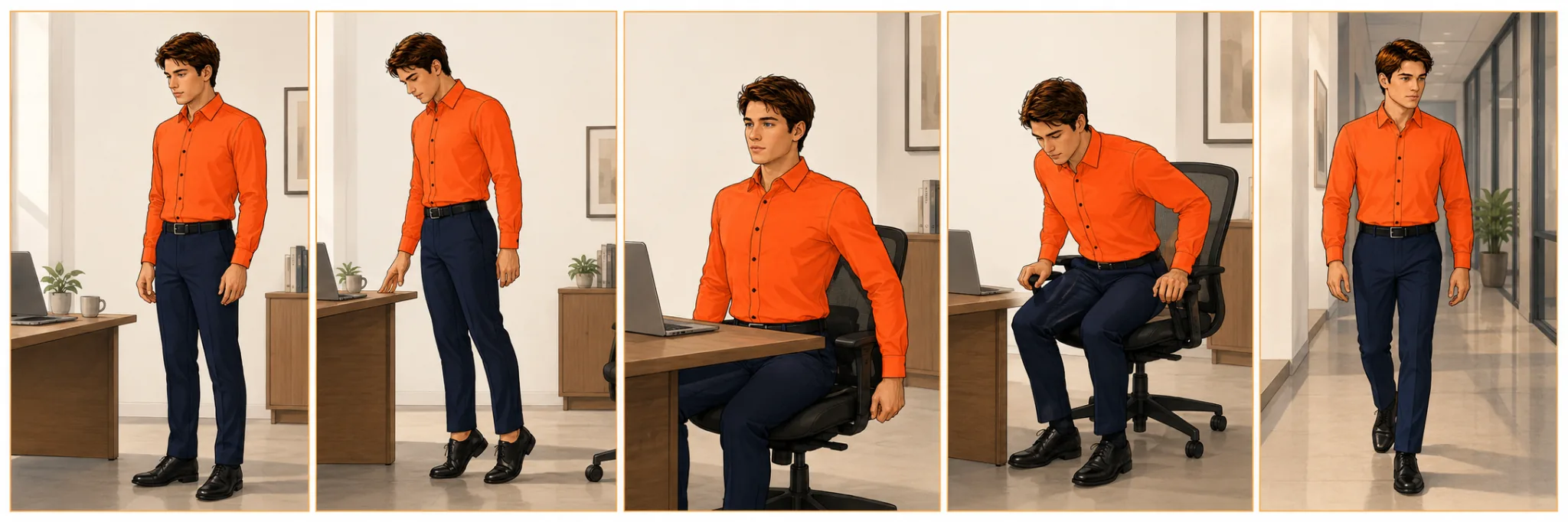
When you want a slightly stronger break that still looks normal: sit toward the front of the chair, feet under your knees, stand smoothly, pause, then sit down slowly and quietly. Repeat 3–5 times, hands for support if needed. It turns an ordinary office transition into a real break. Good before or after lunch, or before a long meeting.
5. Quiet walk-and-return
When your mind feels flat or you’ve been sitting longer than planned: walk to one ordinary destination — water, printer, window, hallway — and return. Don’t power-walk; don’t make it a fitness performance. Walking already belongs in the workplace, so you never have to explain it.
Making it stick — without overthinking
Don’t try all five on day one. Choose one break that feels natural in your workplace and use it once today. If it fits, repeat it tomorrow, then add a second after a few days. The easiest moments to attach a break to are the ones that already exist: after a meeting, before or after lunch, after a long email, or whenever you notice you’ve been sitting too long.
That “attach movement to a moment you already have” idea is the core of habit-building. Here, the one rule to remember is simpler: if a break feels too visible or complicated, you’ll skip it on a busy day. Keep it quiet, keep it small.
What not to do
- Don’t turn every break into a workout. If it leaves you sweaty or distracted, it’s too much for this purpose.
- Don’t force a movement that hurts. Stop anything causing pain, dizziness, sharp discomfort, or unsteady balance.
- Don’t make the plan complicated. Five breaks doesn’t mean five a day. One repeated break beats a perfect routine you abandon.
- Don’t treat standing still as the solution. Standing changes position, but standing without movement is just another stillness. Aim for variety: sit, stand, walk, reset, return.
- Don’t wait until your body is already complaining. A quiet break works best before stiffness gets loud.
Try this once today — the 2-minute quiet reset
Don’t plan a routine, don’t pick all five, don’t wait for the perfect time. Just spend two quiet minutes.
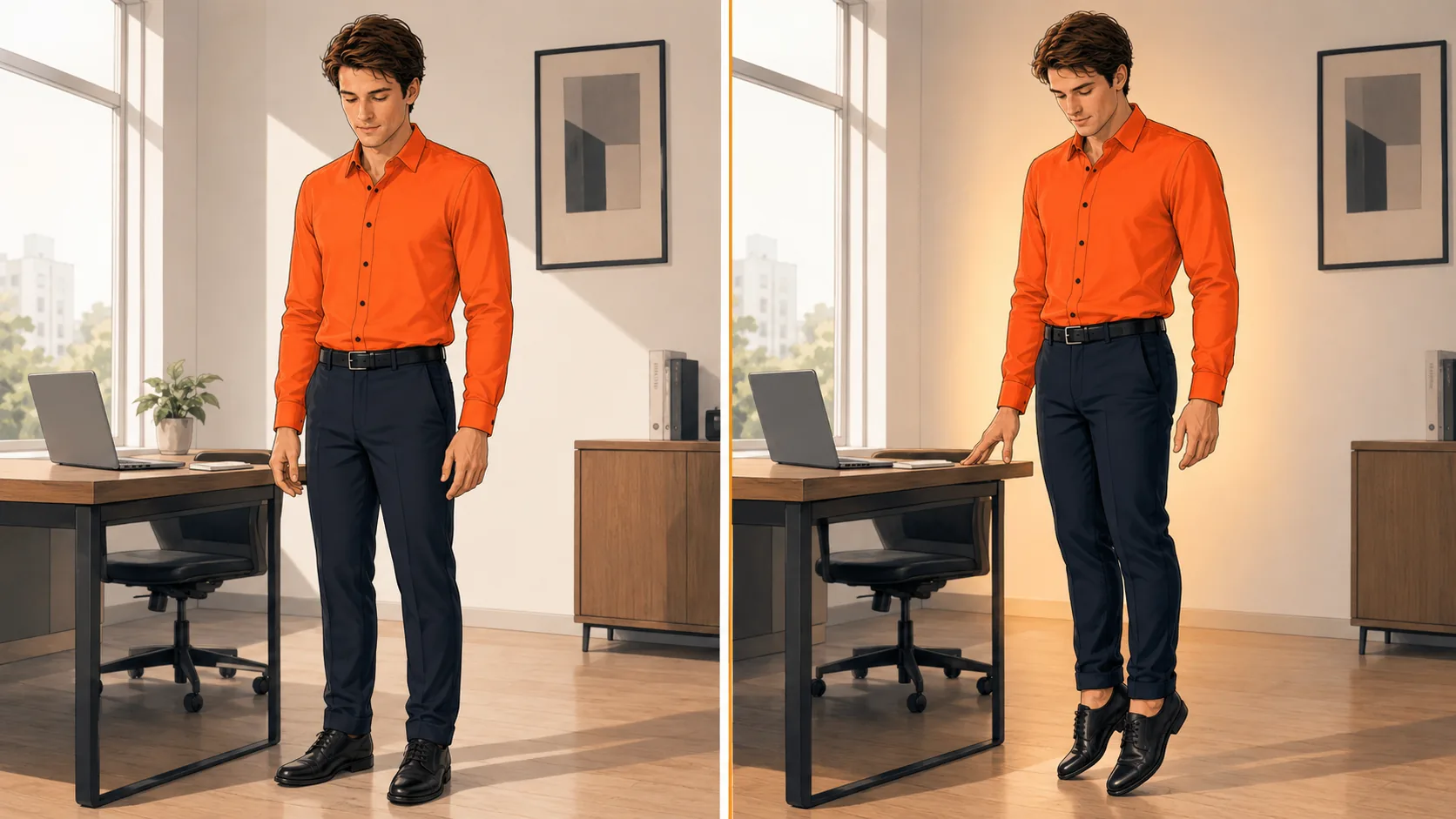
- Minute 1 — stand-and-stack reset: stand beside your chair, feet settled, make yourself gently taller, soften the shoulders, four slow breaths.
- Minute 2 — desk-side calf raises: hold the desk lightly if needed, lift the heels slowly, pause, lower with control, 8–12 times.
Then sit back down and notice one thing: do you feel a little less folded, a little more awake? That’s enough. The point isn’t to transform your day in two minutes — it’s to prove movement fits into the day you already have.
The takeaway
Office movement fails when it asks too much: special clothes, extra time, visible effort, a separate space. Quiet movement breaks ask almost nothing — stand up, shift position, walk briefly, return. That’s the version that survives a real workday.
Choose one break from the five above. Use it once today, at a transition you already have. The goal isn’t a perfect routine. It’s to make movement ordinary enough that it happens before your body has to remind you.

Want the full system?
These five breaks are a simple starting point. If you want a more complete way to build movement into long desk days, Desk Athlete Reset turns small resets into a repeatable daily routine — no gym, no special equipment, no dramatic lifestyle change. Simple movement. Real research. No gym required.
FAQ
Can I do these in formal work clothes?
Yes. They’re designed to be low-noise, low-effort, and possible in normal work clothes. Avoid anything that feels unsafe, painful, or too visible for your workplace.
Are quiet movement breaks a replacement for exercise?
No. They’re small breaks from long sitting, not a replacement for regular activity or medical care.
How many should I do per day?
Start with one. If that feels easy, repeat it twice, then add another at a natural work transition.
What’s the easiest one to start with?
The stand-and-stack reset — just stand beside your chair and take a few slow breaths.
Keep reading
- For why interrupting sitting matters at all, read Sitting Is Not the Enemy — Uninterrupted Sitting Is.
- For the no-time, how-to-start-from-zero version, read Exercise Snacks for People With No Time.
- For the science of short breaks and how often to take them, read The Science of Two-Minute Movement Breaks.
- For why movement quietly disappears at a home desk, read why working from home reduces daily movement.
Sources
- Radwan A, Barnes L, DeResh R, Englund C, Gribanoff S. (2022). Effects of active microbreaks on the physical and mental well-being of office workers: a systematic review. Cogent Engineering, 9(1), 2026206. doi:10.1080/23311916.2022.2026206
- Kitano N, Jindo T, Yoshiba K, Yamaguchi D, Fujii Y, Wakaba K, Maruo K, Kai Y, Arao T. (2025). Effectiveness of short active breaks for reducing sedentary behavior and increasing physical activity among Japanese office workers: one-year quasi-experimental study. Scandinavian Journal of Work, Environment & Health, 51(4), 312–322. sjweh.fi/article/4224
- Batista-Ferreira L, Sandy DD, Silva PCMC, Medeiros-Lima DJM, Rodrigues BM. (2024). Impact of active breaks on sedentary behavior and perception of productivity in office workers. Revista Brasileira de Medicina do Trabalho, 22(2), e20231213. doi:10.47626/1679-4435-2023-1213
- Sandy DD, Silva PCMC, Rodrigues BM, Lima DM, Batista L. (2025). Perception and acceptance of a multicomponent routine program of active breaks for office workers. Revista Brasileira de Medicina do Trabalho, 23(3), e20251451. doi:10.47626/1679-4435-2025-1451
- Landais LL, Jelsma JGM, Dotinga IR, Timmermans DRM, Verhagen EALM, Damman OC. (2022). Office workers’ perspectives on physical activity and sedentary behaviour: a qualitative study. BMC Public Health, 22(1), 621. doi:10.1186/s12889-022-13024-z
FREE TOOLKIT
The Desk Athlete Toolkit
Six printable movement cards you can do right at your desk — no gym, no equipment. One card for every workday moment.
Get the free toolkit