
Written and edited by the LibraryFit editorial team. Last updated June 2026.

Most desk days feel ordinary while they are happening. The stillness builds slowly.
Your body can feel tired even on a day when you barely moved.
You may spend hours at a desk, in a classroom, behind the wheel, or in front of a screen. Nothing feels intense while it is happening. You are just sitting, typing, studying, driving, reading, or answering messages.
But by the end of the day, your neck feels tight. Your back feels heavy. Your hips feel stiff. Your shoulders feel rounded forward. Your focus feels weaker than it should.
That is the problem LibraryFit is built around.
For many people, the issue is not laziness. It is not a lack of discipline. And it is not always a need for harder workouts.
The issue is a modern day filled with long, uninterrupted sitting and too few movement signals.
Sitting itself is not the enemy. Sitting is normal. We sit to work, learn, eat, travel, rest, and think. The real problem begins when sitting becomes the dominant shape of the entire day.
LibraryFit exists for that exact situation: people who sit too much, move too little, and need realistic movement without a gym.
The Real Question
The question is not simply: “Is sitting bad?”
A better question is: “What happens when sitting continues for long periods without interruption?”
That question matters because modern life makes uninterrupted sitting easy. Office workers, remote workers, students, researchers, drivers, freelancers, gamers, and screen-heavy professionals can all spend long blocks of time in one position.
A 2026 scoping review published in Work: A Journal of Prevention, Assessment and Rehabilitation described prolonged sitting as a growing occupational health and ergonomics concern, especially because of its connection with musculoskeletal disorders — particularly affecting the neck, shoulders, upper back, and lower back. Drawing on the research it reviewed, the authors noted that roughly 37.9% of office workers experience musculoskeletal disorders, with the neck, shoulders, and back most commonly involved.
That matters because the problem is not only personal behavior. It is also built into the structure of modern work.
What Counts as Uninterrupted Sitting?
Uninterrupted sitting means staying seated for a long stretch without meaningful movement.
This does not mean you must avoid sitting completely. That would be unrealistic for most people. It means the body should not be locked into one low-movement pattern for hours.
In one office-focused scoping review, prolonged sitting was defined as sedentary behavior lasting two hours or more without substantial physical activity. For a normal person, the practical version is simpler: if you have been sitting so long that your body starts to feel stiff, heavy, or mentally dull, the sitting block has probably gone on too long.
You do not need to panic. You need to interrupt the pattern.
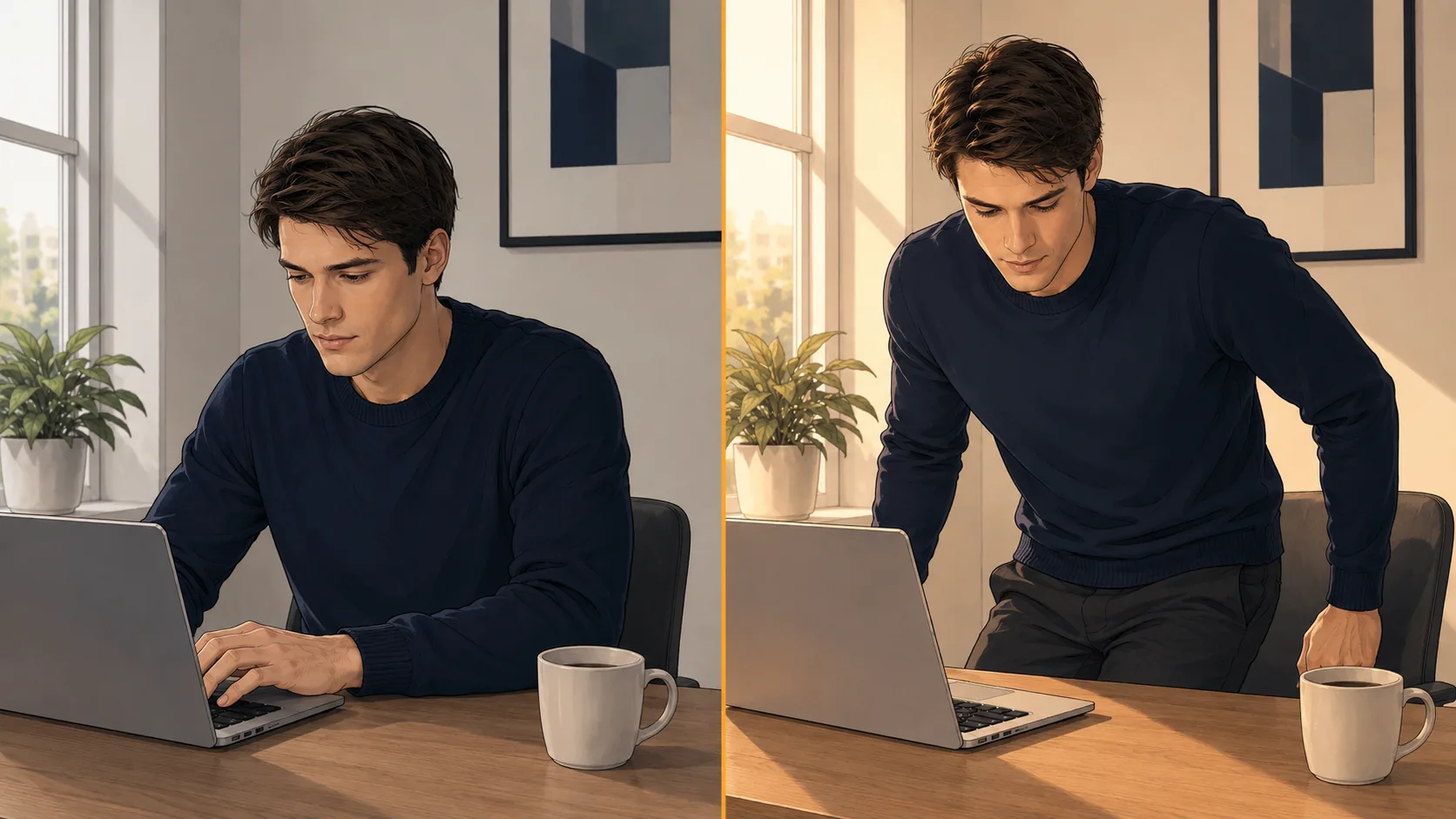
The difference is not dramatic. One panel shows time passing. The other shows the pattern interrupted.
Sitting vs. Sedentary Behavior
Sitting and sedentary behavior are related, but they are not exactly the same thing.
Sitting is a posture.
Sedentary behavior is a low-energy pattern. It usually includes sitting, reclining, or lying down while awake, with very little physical movement.
That difference is important.
You can sit for a short meal and have no problem. You can sit to read for a while and feel fine. But when sitting becomes the default state of the day, the body receives repeated signals of stillness.
Those signals can affect comfort, posture, circulation, energy, and focus. For a closer look at what the research actually says about sedentary behaviour, we cover the evidence in its own article.
LibraryFit does not say: “Never sit.” It says: “Do not let sitting stay uninterrupted for too long.”
Major health bodies make the same distinction. The World Health Organization advises limiting how much time we spend sedentary, noting that higher amounts of sedentary behaviour are associated with poorer health outcomes in adults.
What Researchers Found
Research does not suggest that every minute of sitting is dangerous. The stronger message is about repeated, prolonged, low-movement patterns.
The 2026 scoping review found that self-assessment methods were the most common approach used to study office sitting behavior, representing 69% of studies. It also found that musculoskeletal discomfort most frequently affects the upper body, including the neck, shoulders, and upper back.
If the neck is the part that complains first for you, that pattern has its own explanation in Why Your Neck Hurts After Computer Work.
That balanced message is important for LibraryFit. We do not need fear-based claims. We need practical interpretation.
The body was not designed to stay still in one position for hours without variation. A chair may be comfortable. A desk may be ergonomic. A screen may be positioned well. But even a good setup does not remove the need for movement.
That last point — that even a good chair is not enough on its own — is common enough to have its own article: Why Your Back Hurts Even With a Good Chair.
Ergonomics can reduce strain. Movement breaks interrupt the strain pattern. Both matter.
Do Sitting Breaks Improve Focus?
Many people think movement breaks are only for the body. But if you sit for hours doing mental work, the issue is not only your back or neck. It is also your attention, energy, and mental load.
A 2026 scoping review published in Frontiers in Physiology examined 18 studies involving 694 participants. It found that breaking up prolonged sitting with short physical activity — particularly moderate-intensity walking for 3 minutes every 30 minutes — improved attention and executive function in several studies.
The review also found that active breaks appear to have positive effects on muscle health, and that even brief physical activity may help maintain cognitive performance compared to uninterrupted sitting.
One honest note: of all these benefits, the evidence for focus and thinking is the weakest and most mixed. Several studies found no clear change in cognition. So treat a movement break as support for your mind, not a guaranteed boost.
This is exactly the kind of honest evidence LibraryFit uses. A movement break is not a magic button for perfect focus. But it may help you maintain your body and mind better than sitting without interruption.
The practical takeaway is simple: do not wait until your brain feels empty and your body feels stiff. Move before the crash.
Sitting Breaks Are Not Just About Posture
Movement breaks may also matter after meals.
A network meta-analysis of 30 randomized crossover trials found that both light- and moderate-intensity physical activity interruptions significantly reduced post-meal glucose and insulin responses compared with prolonged sitting alone.
Moderate-intensity activity breaks were the most effective overall. Compared with uninterrupted sitting, they lowered post-meal glucose with a standardized mean difference of about -0.69 (95% CI: -1.00 to -0.37) and post-meal insulin with a standardized mean difference of about -0.47 (95% CI: -0.77 to -0.17).
This does not mean everyone needs to do intense exercise during work.
It means the body responds differently when sitting is interrupted by movement. A short walk is not just a break from work. It is a different signal to the body.
This is one of the most important LibraryFit principles: small movement can matter because it changes the pattern.
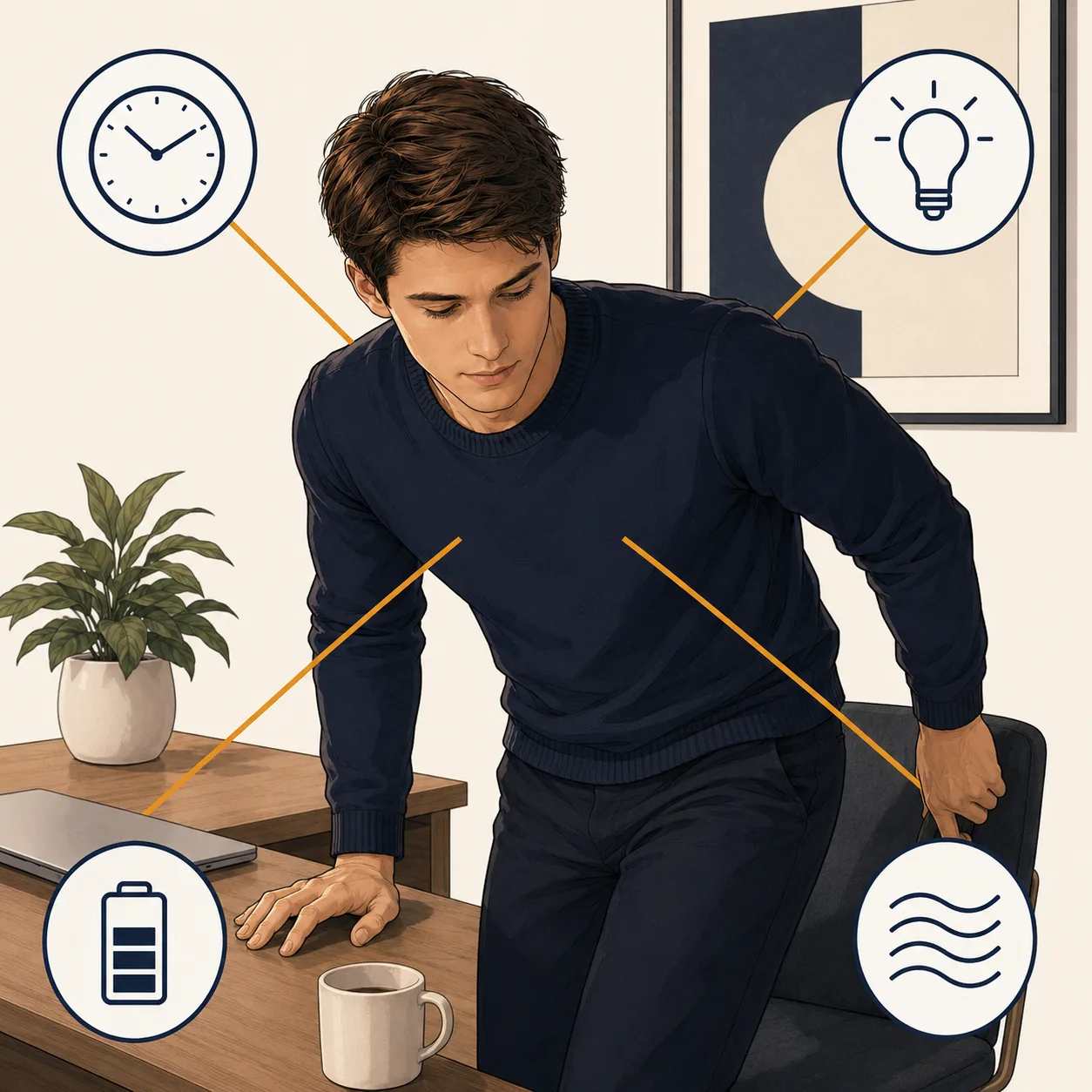
One small movement. Four signals to the body.
How Often Should You Break Sitting?
There is no single perfect rule that applies to everyone.
Different studies use different break schedules. Some use walking every 20 minutes, others every 30 or 60 minutes. Some use bodyweight movements or stair climbing.
The research suggests that breaking up sitting more frequently produces stronger metabolic and comfort benefits than waiting for one longer break.
The deeper research behind how often to move — and what the studies actually measured — is the focus of The Science of Two-Minute Movement Breaks.
So instead of pretending there is one perfect answer, start with a realistic rule: break sitting before your body starts complaining loudly.
For many people, that means trying one brief break every 30–60 minutes. That break does not need to be intense. It can be:
- Standing up and walking for one or two minutes
- Gentle shoulder rolls or neck stretches
- A short stair walk
- A few slow chair squats
- Stretching the hips or calves
- Breathing tall away from the screen
The goal is not to create a workout. The goal is to interrupt stillness.
What About Exercise Snacks?
Exercise snacks are one of the most practical ways to break prolonged sitting.
A 2025 systematic review in Healthcare covering 26 studies published between 2012 and 2025 describes exercise snacks as brief intermittent activity bouts, typically lasting 1–5 minutes.
These short bouts can interrupt sedentary behavior and support health outcomes across several domains, including metabolic health, cardiovascular function, cognitive performance, and physical function.
Adherence rates in feasibility studies exceeded 80%, meaning people can actually stick to them.
This idea fits LibraryFit perfectly because most people do not fail at fitness because they hate health. They fail because the plan does not fit real life.
A 60-minute workout may be difficult on a busy day. A 2-minute movement break is much easier to begin.
Exercise snacks should not replace all structured exercise. The research presents exercise snacking as a complementary approach, not a substitute for traditional exercise.
If exercise snacks sound like the realistic place to start, we walk through exactly how to use them in Exercise Snacks for People With No Time.
That is a strong and honest message: you can still benefit from regular exercise, but you can also stop treating the workday as physically neutral.
Why This Matters for People Who Sit Too Much
Most fitness advice assumes you have time, space, gym clothes, equipment, and energy.
But many people do not.

This is not about one type of person. It is about any day built around long, uninterrupted sitting.
A student may sit through long study sessions. A remote worker may move less at home than in an office. A driver may sit for hours with few chances to walk. A researcher may spend the day reading, writing, and analyzing. A freelancer may move from laptop to phone to another screen without noticing the day passing.
These people do not need guilt. They need a realistic first step.
The first step is not: “Go train hard for an hour.” The first step is: “Interrupt the long sitting pattern.”
That can be done with a short walk, a standing reset, a few gentle mobility movements, or a brief exercise snack.
Start where your real life is.
Common Mistakes People Make
Mistake 1: Waiting until the end of the day
Many people sit all day and hope one workout later will fix everything. A workout is valuable. But it does not change the fact that your body spent hours without movement signals. LibraryFit does not ask you to choose between exercise and movement breaks. It asks you to use both intelligently.
Mistake 2: Thinking standing is enough
Standing can help reduce sitting time, but standing still is not the same as moving. The body still needs variation. A better goal is: Sit, stand, walk, reset, repeat.
Mistake 3: Making breaks too complicated
If a break needs special clothes, a mat, equipment, or privacy, most people will skip it. The best movement break is the one you will actually do.
Mistake 4: Waiting for pain
Do not wait until your neck hurts or your lower back feels heavy. Movement breaks work best as prevention signals, not emergency repairs.
Mistake 5: Trying to be perfect
You will miss breaks. You will forget. You will have busy days. That is normal. The goal is not perfection. The goal is to build a day with more movement signals than before.
Try This Once Today — The 2-Minute Sitting Reset
- Stand up slowly.
- Take three slow breaths while standing tall.
- Roll your shoulders gently backward.
- Walk for one minute.
- Return to your work with your screen, chair, and posture reset.
This is not a full workout. It is a signal.
A signal that your workday is not allowed to trap your body in one position for hours.
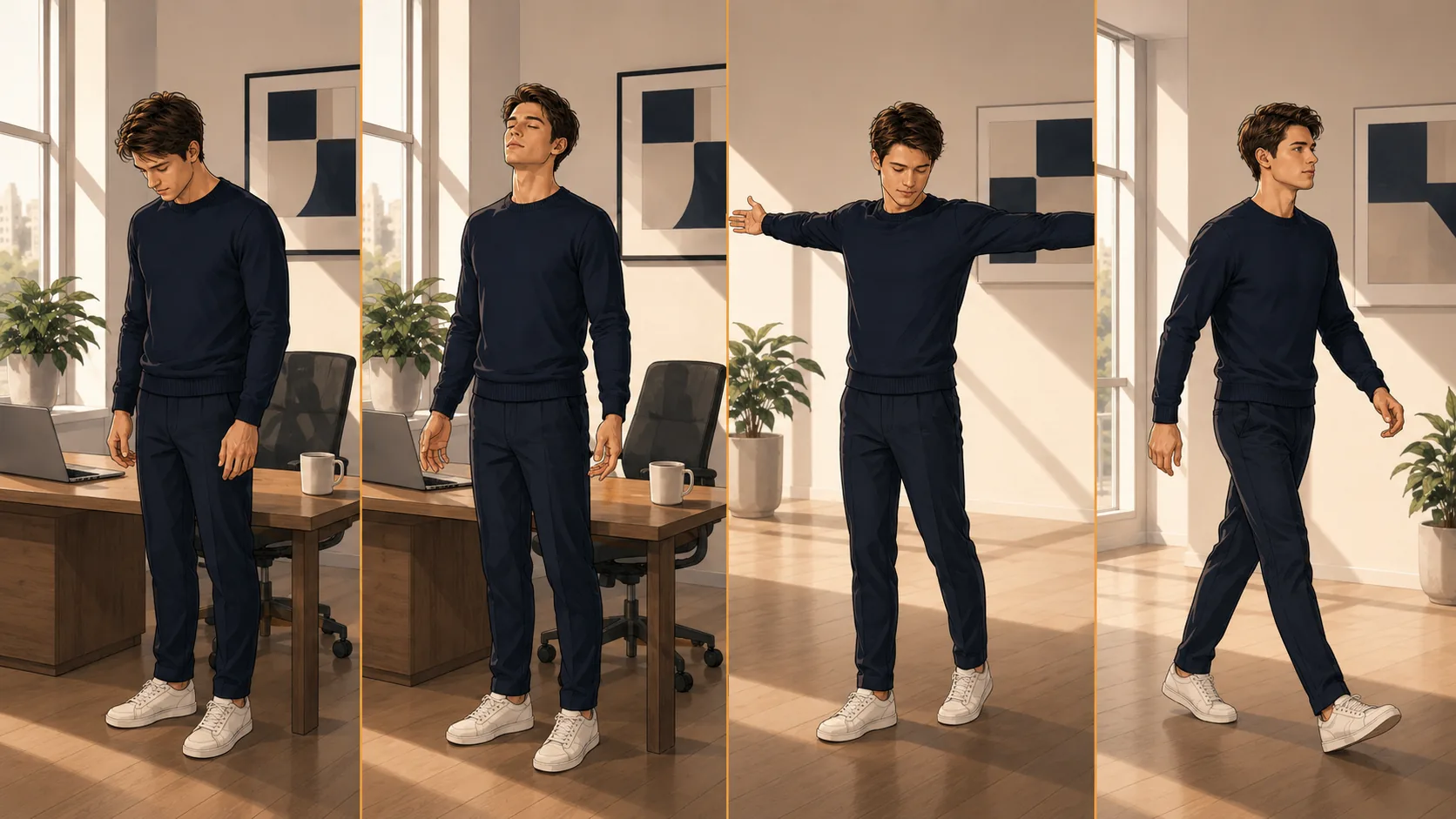
Stand. Breathe. Open. Walk. Two minutes is enough to interrupt the pattern.
LibraryFit Takeaway
Sitting is not the enemy. Uninterrupted sitting is the pattern to change.
Start smaller. Break the sitting pattern. Give your body regular movement signals during the day.
Note: This article is for general education only and is not medical advice. If you have a health condition, ongoing pain, or specific concerns, check with a qualified professional before changing your activity habits.
If your workday regularly leaves your body stiff, tired, and low on energy, Desk Athlete Reset is designed for people with low-movement workdays — a simple system to interrupt the pattern, restore posture, and build no-gym strength.
FAQ
Is sitting always bad?
No. Sitting is normal. The concern is long, repeated, uninterrupted sitting with very little movement during the day.
Is standing better than sitting?
Standing can reduce sitting time, but standing still is not the same as movement. The best approach is to create more variation: sit, stand, walk, and reset.
How long should a movement break be?
Start with 1–2 minutes. That is enough to interrupt the pattern and make the habit easier to repeat.
Do I need to sweat?
No. LibraryFit focuses on realistic movement. Some breaks can be light and quiet. Others can be more active, depending on your space, clothing, and energy.
Are exercise snacks the same as workouts?
No. Exercise snacks are short bouts of movement during the day. They complement structured exercise. They do not have to replace it.
What to Read Next
This article is the starting point. If you want to go deeper, these build directly on it:
- The Science of Two-Minute Movement Breaks — the research behind why short breaks help.
- Exercise Snacks for People With No Time — the easiest way to start when your day is already full.
- Why Your Neck Hurts After Computer Work — when the neck is the part that complains first.
- Why Your Back Hurts Even With a Good Chair — why a good chair alone is not enough.
- Tight Hip Flexors From Desk Work — the front-of-hip pattern that quietly builds up over a sitting day.
Want the Full System?
This article gives you the first idea: interrupt long sitting.
But if your workday regularly leaves your body stiff, tired, and low on energy, you may need a more complete system.
Desk Athlete Reset is designed for people with low-movement workdays. It uses a simple structure:
- 5 minutes to interrupt the workday pattern
- 12 minutes to restore posture and breathing
- 30 minutes to build no-gym strength
LibraryFit gives you the research-backed starting points. Desk Athlete Reset gives you the full system.
Sources
Behzad, A., Kim, E., & Chung, J. (2026). Prolonged sitting in office environments: A scoping review of assessment methods. Work: A Journal of Prevention, Assessment and Rehabilitation, 84(1), 20–41.
Freyer, M., Jost, C., Jankowiak, S., Bressem, K.-A., & Hegewald, J. (2026). Evaluating the methods used to examine sitting breaks and their influence on mental load, physical strain, and cognitive performance — a scoping review. Frontiers in Physiology, 17, 1755356.
Quan, M., Xun, P., Wu, H., Wang, J., Cheng, W., Cao, M., Zhou, T., Huang, T., Gao, Z., & Chen, P. (2021). Effects of interrupting prolonged sitting on postprandial glycemia and insulin responses: A network meta-analysis. Journal of Sport and Health Science, 10(4), 419–429.
Alexe, D. I., Saha, S., Choudhary, P. K., Alexe, C. I., Choudhary, S., & Tohănean, D. I. (2025). Exercise snacks as a strategy to interrupt sedentary behavior: A systematic review of health outcomes and feasibility. Healthcare, 13, 3216.
FREE TOOLKIT
The Desk Athlete Toolkit
Six printable movement cards you can do right at your desk — no gym, no equipment. One card for every workday moment.
Get the free toolkit