
Written and edited by the LibraryFit editorial team. Last updated June 2026.
You already know sitting all day isn’t great for you. Knowing it doesn’t help much, though — you still have work to finish, a screen in front of you, and a chair under you that quietly turns into six, seven, or eight hours before you notice.
Then your body starts talking. Tight hips. A heavy lower back. A neck that drifts toward the screen. Legs that feel half-asleep. Focus that goes flat even though you’re technically still working.
So the useful question isn’t “is sitting bad?” It’s this: can a two-minute movement break actually make a difference when you sit for long stretches?
The honest answer is yes — but not because two minutes is magic, and not because it cancels out a sedentary day. It helps because it interrupts the pattern. LibraryFit isn’t here to scare you off your chair. We’re here to help you use your desk day differently.
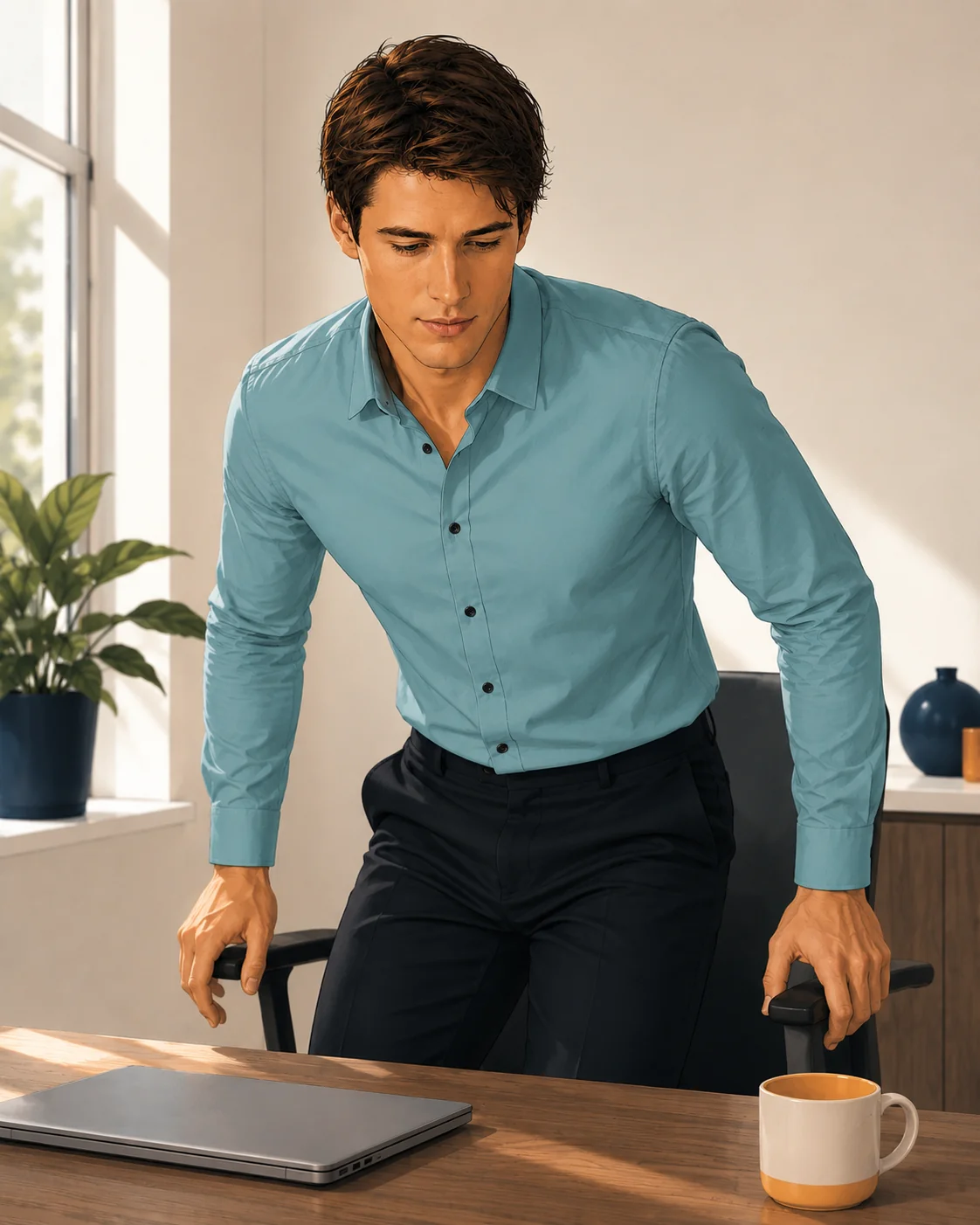
The one number worth watching
Most advice tells you to move more. But the research keeps pointing somewhere more specific and more useful for desk workers: it’s not how much you move in total that the body struggles with most — it’s how long you stay completely still in one block.
So here’s the number we’d ask you to watch instead of your step count:
Your longest unbroken sitting block.
If your day is one four-hour block of stillness, that’s the thing to break. Not by training for a marathon — by interrupting it. Shrink your longest block, and you’ve pulled the lever the research actually points at. The two-minute break is simply the tool that does it.

What the research actually shows
Researchers use a few names for the same idea — movement breaks, active breaks, sitting interruptions, and exercise snacks. They all point one direction: short, repeatable bursts of activity that break up long sitting. (If you want the practical, no-time guide to exercise snacks specifically — what they are and how to start — that’s a separate piece: Exercise Snacks for People With No Time. This article is about what the breaks do to your body and how often they’re worth taking.)
The strongest evidence sits in metabolic health. When people break up long sitting with short bursts of light activity, their bodies tend to handle blood sugar better — especially after meals, and especially in middle-aged and older adults who already carry more metabolic risk. A meta-analysis by Yin and colleagues found this effect on blood sugar and insulin was real and moved in a consistent direction, though the studies varied in size — while the same short breaks didn’t do much for blood-fat markers in the short term.
That split — clear gains for blood sugar and insulin, little for blood fats — is worth sitting with for a second, because it’s the honest shape of the truth: movement breaks help some things more than others. A result that helps everything equally is usually a result you shouldn’t trust.
For stiffness and muscle fatigue, the picture is promising but less settled — studies use different break types and measure different things, so we can say breaks appear to help how the body feels through a long day, without pretending it’s nailed down.
Focus is the least settled piece of all. A broad review by Alexe and colleagues counts sharper thinking among the possible benefits, but across individual studies the results are genuinely mixed. So we won’t promise movement breaks will clear your afternoon fog. For some people they seem to help; for others the effect is small or unclear.
And the office angle: reviews of desk work link long, static sitting to neck, shoulder, and back complaints, and list breaking up sitting among the practical things people can actually do about it. Note the word link — that’s an association, not proof that sitting alone causes your back pain.
This lines up with public-health guidance too. The World Health Organization recommends limiting how much time we spend sedentary, noting that higher amounts of sedentary behaviour are associated with poorer health outcomes in adults.
Standing isn’t the same as moving
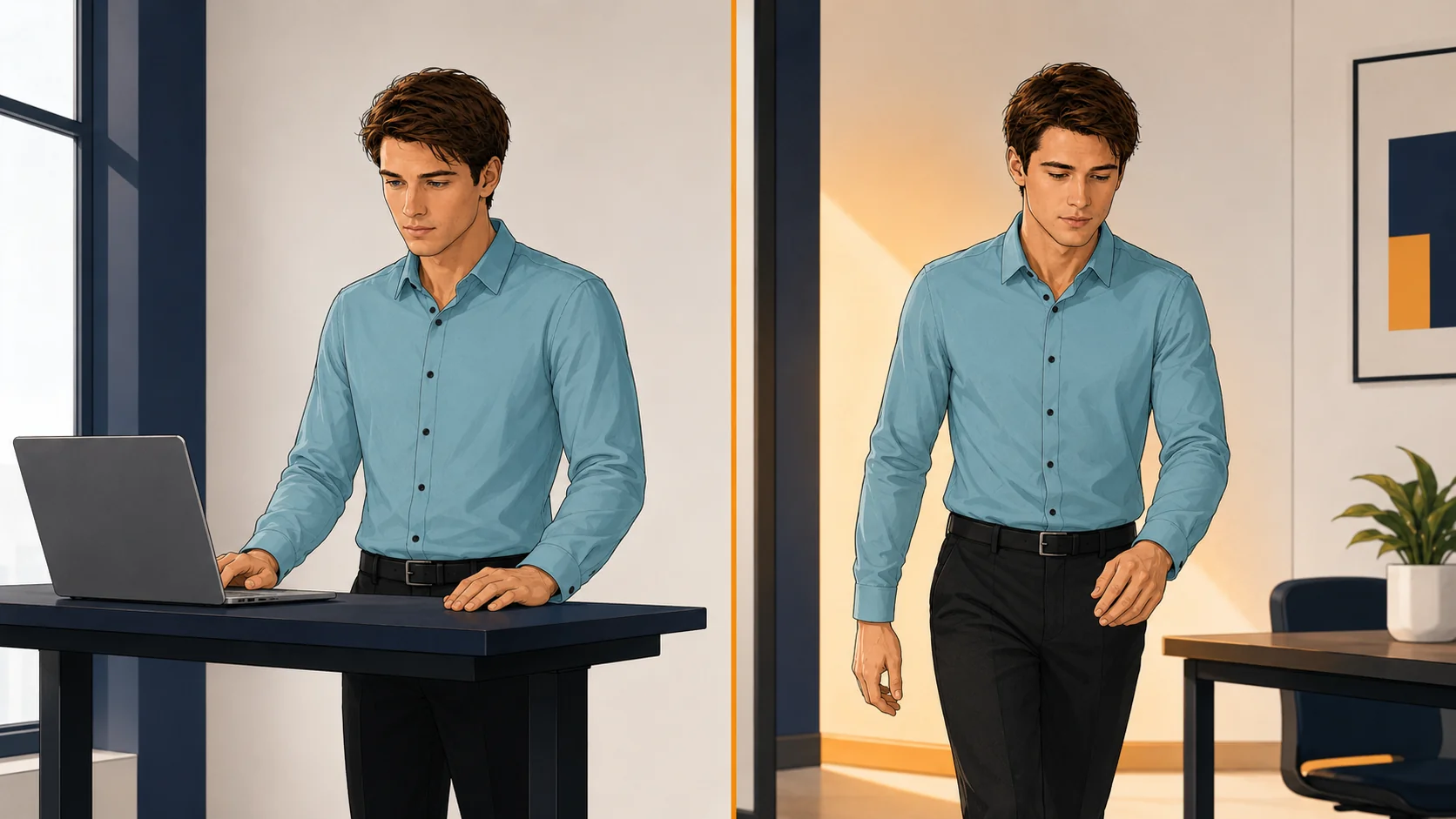
Standing helps. It changes your position and breaks the trapped-in-the-chair feeling. But standing is a posture, and a movement break is an action — and that difference matters.
The clearer metabolic benefits in the research come from replacing sitting with light activity like walking or simple movement, not just from standing up. A standing desk is a good upgrade to your day. It isn’t the whole answer.
So the better rhythm isn’t “sit or stand.” It’s: sit, stand, move, return — and repeat.
What to actually do in two minutes
Keep it almost too simple to skip. Pick one:
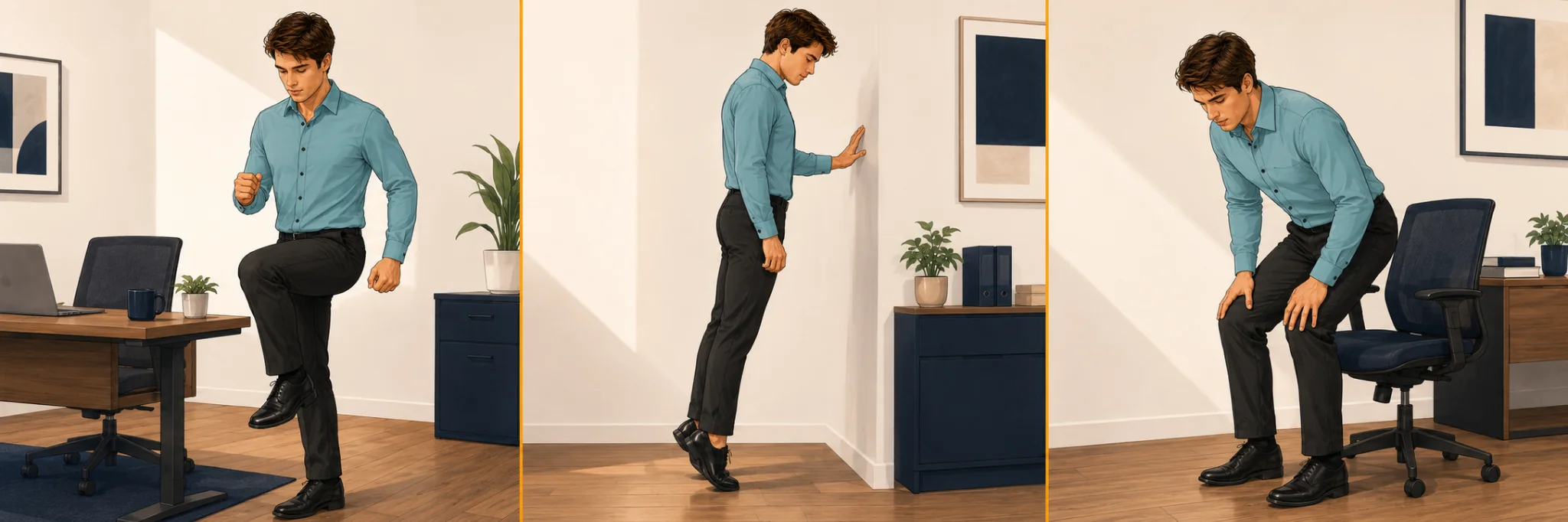
- Walk around the room or down the hall and back
- March in place beside your desk
- Slow sit-to-stands from your chair
- Gentle calf raises
- One short flight of stairs
- Walk while you take a phone call
The best option is the one you’ll repeat on a bad day. In an office, walking is easiest. Working from home, marching in place is plenty. Stuck at your desk, sit-to-stands and calf raises work. Sleepy after lunch? A short walk is the place to start.
You’re not trying to burn calories or impress anyone. You’re interrupting the stillness — that’s the entire job.
How often?
There’s no perfect schedule. But the research often uses breaks every 30 to 60 minutes, which gives a realistic starting point:
- If you sit almost nonstop, aim for two minutes every 30 minutes
- If that’s too much, try every 45 to 60 minutes
- If your day is chaos, start with three anchor breaks: mid-morning, after lunch, mid-afternoon
- If post-meal energy is your problem, a short walk after eating is a smart place to spend two minutes
The goal isn’t a perfect timer. It’s fewer long, unbroken blocks.
The LibraryFit two-minute reset
For the days you don’t want to think:
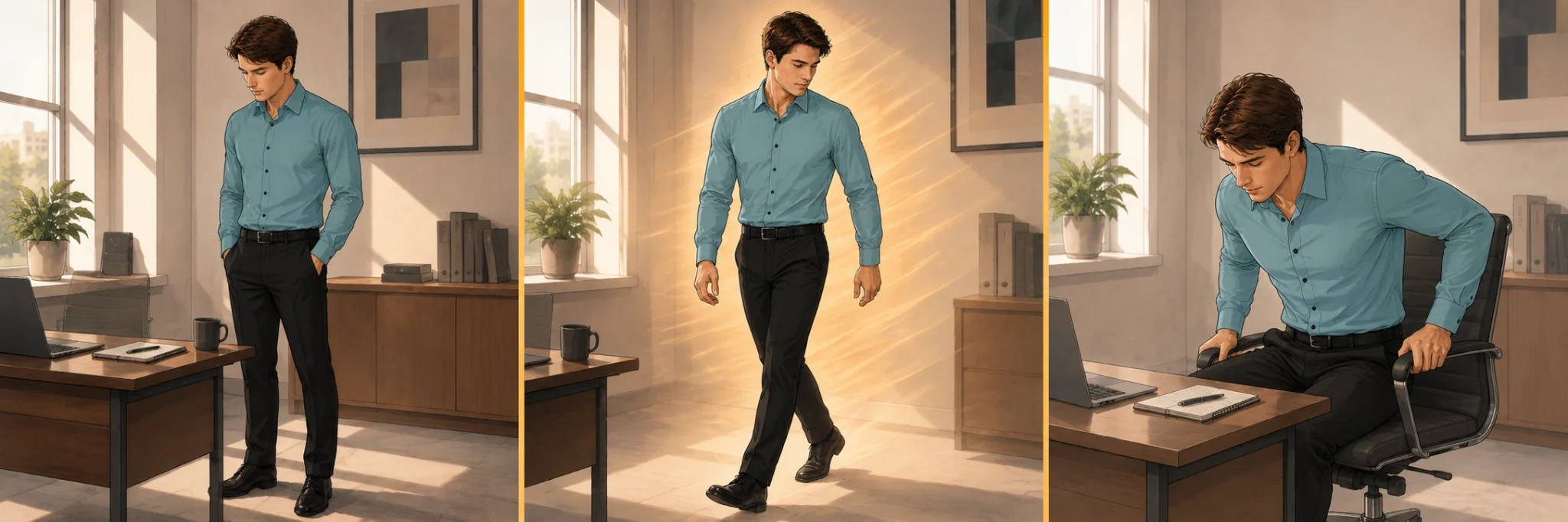
- 30 seconds — stand up and reset your posture
- 60 seconds — walk, march in place, or do slow sit-to-stands
- 30 seconds — breathe, lengthen, and sit back down on purpose
That’s enough to start. The point was never intensity. It’s interruption.
What this won’t do
This part matters, because honest limits are what make the rest of the article trustworthy.
A two-minute movement break may help you interrupt long sitting blocks, feel less physically stuck, wake up the legs and hips during the workday, support blood-sugar handling when you repeat it, and build a movement habit that survives a busy day.
It won’t cure back pain, treat diabetes, replace structured exercise or strength work, erase a bad night’s sleep, or transform your body shape on its own. Anyone promising that is selling something.
So treat movement breaks as a starting point, not a finish line. You still benefit from regular activity, strength work, sleep, and a decent workspace. But when your specific problem is that you sit too long without interruption, a small break is the right first move.
Common mistakes
- Waiting for pain. Move before your back or hips force you to. The break works best before the body complains.
- Thinking it has to be intense. Light activity, repeated, is enough. This isn’t a workout.
- Standing and calling it done. Standing changes your position; movement changes the signal your body gets.
- Exercising once, then sitting still all day. A workout is great. It doesn’t make eight unbroken hours disappear. Breaks and exercise are partners.
- Over-complicating it. If your break needs a checklist, you’ll quit. Keep it simple enough for a bad day.
Who should be careful
Most two-minute breaks are simple and low-risk, but not every movement suits every body. If you have dizziness, balance issues, chest pain, severe joint pain, recent surgery, or a condition that limits activity, check with a qualified health professional before changing your routine. Choose movements that feel controlled and comfortable. You’re making movement easier to include — not forcing it.
Try this once today
Set a timer for your next sitting block. After 30 to 60 minutes, stand up and do this:
- 30 seconds standing tall, breathing normally
- 60 seconds walking around the room or marching in place
- 30 seconds resetting your shoulders, hips, and breathing before you sit again
Then ask one question: do I feel a little less stuck than before? That’s the first win. Don’t judge the habit by one break — judge it by what your day feels like once it becomes normal.
The takeaway
Two minutes isn’t magic. But two minutes is realistic — and for people who sit too much, realistic is what actually changes a day.
The research suggests short, repeated breaks can help interrupt long sitting, with the strongest evidence for blood-sugar handling, promising signs for stiffness and fatigue, and a genuinely mixed picture for focus. You don’t need to become an athlete at your desk. You need to stop being still for too long.
Stand up. Move for two minutes. Sit down differently. Then watch one number drop: your longest unbroken block.
Want the full system?
This article gives you one habit: interrupt long sitting with short breaks. But if your workday regularly leaves you stiff, tired, and low on energy, you may want a fuller structure. Desk Athlete Reset is built for low-movement workdays and turns simple movement into a practical system — five minutes to interrupt the pattern, twelve to restore posture and breathing, thirty to build no-gym strength. LibraryFit gives you the research-backed starting points. Desk Athlete Reset gives you the full system.
FAQ
Are two-minute movement breaks enough? They’re enough to interrupt a long sitting block, but not a full fitness program. Think of them as a way to break stillness, not a replacement for exercise.
How often should I take them? A realistic start is every 30 to 60 minutes. If you sit nonstop, try every 30. If that feels unrealistic, begin at 45 to 60.
Do I need to sweat? No. Walking, marching in place, slow sit-to-stands, or calf raises all count. The goal is to move, not to exhaust yourself.
Is standing the same as a movement break? No. Standing changes your position; movement does more for the body’s signals. A good day uses both.
Are movement breaks the same as “exercise snacks”? They’re closely related — “exercise snacks” is the research term, “movement breaks” is our everyday word for it. If you specifically want the no-time, how-to-start guide to exercise snacks, that’s covered in Exercise Snacks for People With No Time.
Will they fix my focus? Maybe — for some people. The research on focus is mixed, so we make no promises there. The evidence is stronger for interrupting sitting and supporting blood-sugar handling than for sharpening attention.
Should I still exercise if I take breaks? Yes. Breaks aren’t a replacement for regular activity or strength work. They stop your desk day from becoming one long block of stillness.
What to read next
- For the no-time, how-do-I-actually-start guide — friction, triggers, and the best movements to begin with — read Exercise Snacks for People With No Time.
- If sitting leaves your neck and shoulders stiff, read Why Your Neck Hurts After Computer Work.
- For the bigger problem behind the habit, read Sitting Is Not the Enemy — Uninterrupted Sitting Is.
Sources
- Behzad A, Kim E, Chung J. (2026). Prolonged sitting in office environments: a scoping review of assessment methods. Work: A Journal of Prevention, Assessment and Rehabilitation, 84(1), 20–41. doi:10.1177/10519815251396853
- Alexe DI, Saha S, Choudhary PK, et al. (2025). Exercise snacks as a strategy to interrupt sedentary behavior: a systematic review of health outcomes and feasibility. Healthcare, 13, 3216. doi:10.3390/healthcare13243216
- Yin M, Zheng H, Han B, et al. (2025). Every move counts: acute effects of sedentary breaks on glucose and lipid metabolism in middle-aged and older adults — a multi-level meta-analysis. Read on ScienceDirect
FREE TOOLKIT
The Desk Athlete Toolkit
Six printable movement cards you can do right at your desk — no gym, no equipment. One card for every workday moment.
Get the free toolkit