Written and edited by the LibraryFit editorial team. Last updated June 2026.
Can tiny movement bouts break up a sitting day?
Most people don’t need another lecture about exercise. You already know movement matters. You already know sitting all day isn’t ideal. Knowing isn’t the problem.
The problem is the shape of your day — and the friction between you and getting started.
A modern sitting day traps you before you notice. You sit to work, sit to study, sit to drive, sit to eat, sit to answer messages, then sit to rest from all the sitting. By late afternoon your shoulders are tight, your hips feel quiet, and your energy is lower than it should be. Then someone says, “you should exercise more.” They might be right. But they’re skipping the part that matters most: where is the time supposed to come from?
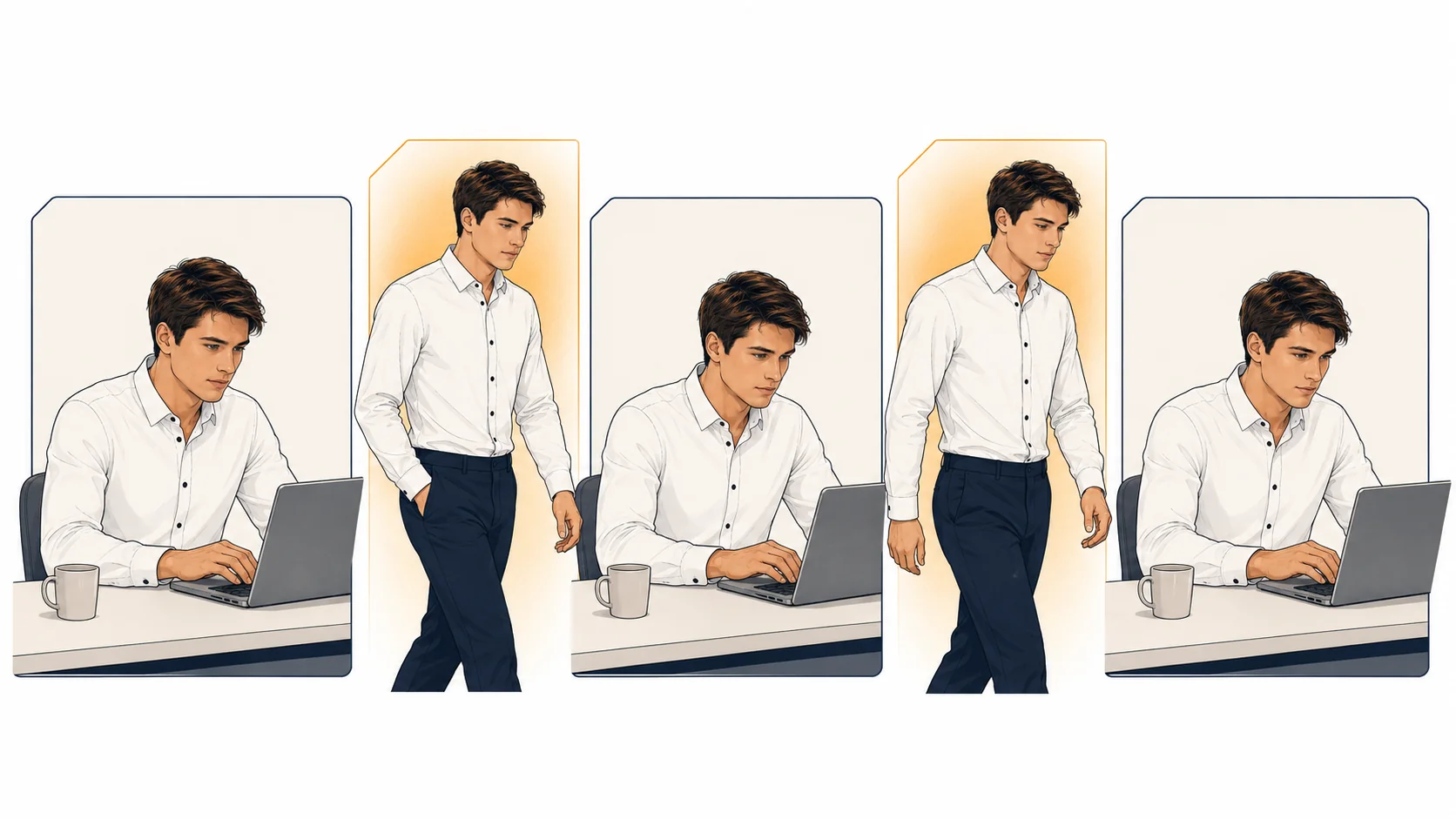
That’s where exercise snacks earn their place. An exercise snack is a short, intentional bout of movement dropped into the day — one minute, two minutes, five. No gym. No workout clothes. No turning your life into a fitness project. It just interrupts the stillness. For someone who currently does nothing across a long sitting day, that small interruption is the most realistic place to start.
This article is about how to actually start. For the science of why breaking up sitting helps your body, we go deep in a companion piece — The Science of Two-Minute Movement Breaks. Here, the job is different: beating the friction.
What are exercise snacks?
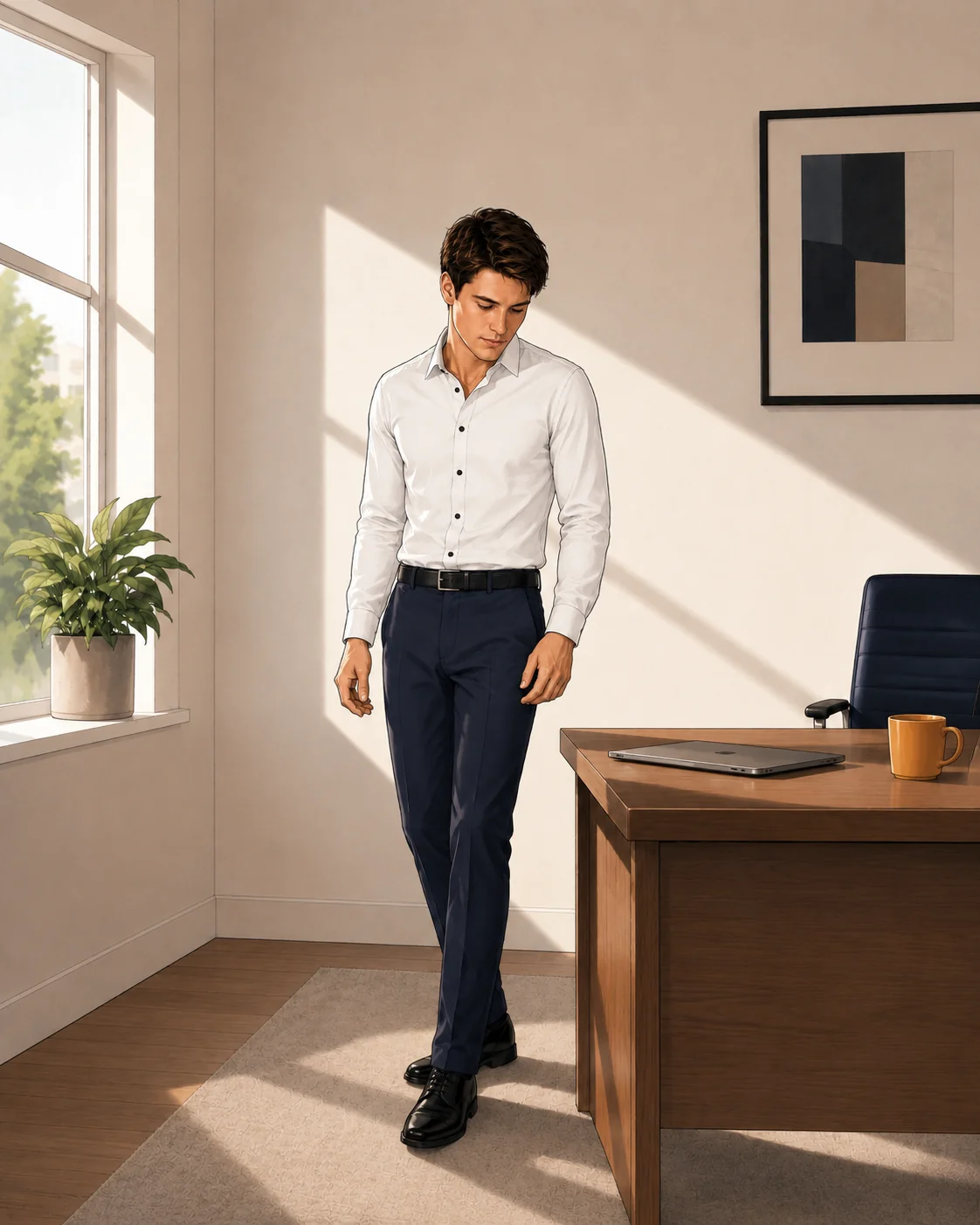
Exercise snacks are brief bursts of movement spread across the day. They’re called “snacks” because they’re small, separate, and easy to slot between bigger parts of the day. A workout asks for a block of time. An exercise snack asks for a moment.
That moment might be a two-minute walk after lunch, five slow chair squats before the next email, ten calf raises beside your desk, one short flight of stairs, a minute of marching in place, or a quick standing reset after a long screen session. The movement doesn’t have to be impressive. It has to be repeatable. That’s the whole idea.
A broad research review (Alexe and colleagues) describes exercise snacks as short activity bouts used to break up prolonged sitting — valued mainly because they’re easier to fit into a real day than a traditional workout. That’s the point. They’re not better than exercise. They’re easier to start.
Why this works when willpower doesn’t
Here’s the honest reason exercise snacks fit busy people: the first enemy usually isn’t weakness. It’s friction.
Traditional advice starts too far ahead — “go to the gym,” “train five days a week,” “get 150 minutes.” Useful eventually, but to a tired, sitting-heavy person it feels like being handed a mountain when they asked for a first step. Every barrier (changing clothes, finding time, leaving the building, feeling self-conscious) is a reason to not start. Exercise snacks remove those barriers. You don’t change, don’t travel, don’t need equipment, don’t need a perfect plan, don’t wait until Monday. You just need a short movement you can repeat.
There’s also an identity barrier worth naming. A lot of people quietly believe “I’m not a fitness person.” Exercise snacks don’t ask you to become one. They don’t ask, can you become an athlete today? They ask, can you interrupt one sitting block today? That’s a smaller, kinder, and far more answerable question — and it’s exactly the LibraryFit approach: simple movement, real research, no gym required.
What the research actually supports
Exercise snacks are promising, not magic. The protocols in the research vary a lot — some use vigorous stair climbing, others use gentle walking — so the honest summary is “helpful, with limits.” A few findings are worth knowing:
They can help your body handle a sitting day better. Breaking up sitting with short activity has measurable effects on things like blood-sugar handling. We cover that evidence in detail in The Science of Two-Minute Movement Breaks, so we won’t repeat it here — just know the metabolic case is the strongest part of the picture.
They can support fitness — but mostly the vigorous kind. A review by Wan and colleagues found exercise snacks improved cardiorespiratory fitness and lowered some cholesterol readings. Important detail, though: those fitness gains came from higher-intensity bursts, and the review noted bouts longer than two minutes worked better for fitness. The same review found no change in body weight or body fat — so this is not a weight-loss tool, and any article selling it that way is overreaching.
People actually accept them at work. In a workplace study (Stork and colleagues), staff climbed a few flights of stairs in short bursts through the day, versus doing the same stairs as one compact high-intensity session. On the whole, participants found the spread-out “snack” version more pleasant and less effortful than the single harder session. Small study — just 14 people — but it points at something real: people stick with what doesn’t feel like punishment.
Early signs on focus are interesting — and only early. A small pilot (Mues and colleagues) had sedentary office workers do three one-minute bursts of vigorous running in place, four days a week for four weeks. Cognitive test scores improved. But it was a small pilot and the movement was vigorous, so treat it as early and promising — not a guaranteed productivity hack.
The intensity spectrum: start gentle, earn vigorous
This is the part most “exercise snacks” content gets wrong, so it’s worth slowing down.
Notice that the impressive results above — the fitness gains, the cognitive boost — came from vigorous snacks. A gentle two-minute walk will not raise your VO2max. And that’s completely fine, because a gentle snack has a different job: it interrupts the sitting. That alone is worth doing, and it’s where almost everyone should start.
Think of it as a spectrum, not a switch:
- Gentle (start here): walking, calf raises, easy chair squats. Job: break the stillness, build the habit.
- Moderate (add when the habit sticks): brisk walking, more squats, a flight of stairs at a steady pace.
- Vigorous (optional, later): stair sprints, fast bodyweight work, running in place. This is where the bigger fitness and focus effects show up — but it’s a reason to add intensity after the habit is solid, never a reason to make your first snack hard.
If your first exercise snack makes you dread the second one, it was too hard. Back off. The habit is the asset; intensity is something you spend later.
What exercise snacks cannot do
Trust comes from saying what doesn’t follow from the evidence, not just what does. Exercise snacks are not a complete strength program, not a full cardio plan, not a guaranteed way to lose weight, and not an eraser for a whole day of sitting. They don’t make sleep, food, stress, and regular activity irrelevant. And they’re not automatically safe for everyone at every intensity.
They’re best understood as one layer — a useful, practical, easy-to-start layer that interrupts the sitting pattern. A sitting-heavy body usually needs more than one tool over time: movement breaks, posture resets, some strength work, better work rhythms. Exercise snacks are simply the first tool, because they’re the easiest to begin.
The best exercise snacks for a sitting day
The best one isn’t the hardest — it’s the one you’ll actually repeat. For most people, start simple, safe, and low-friction.
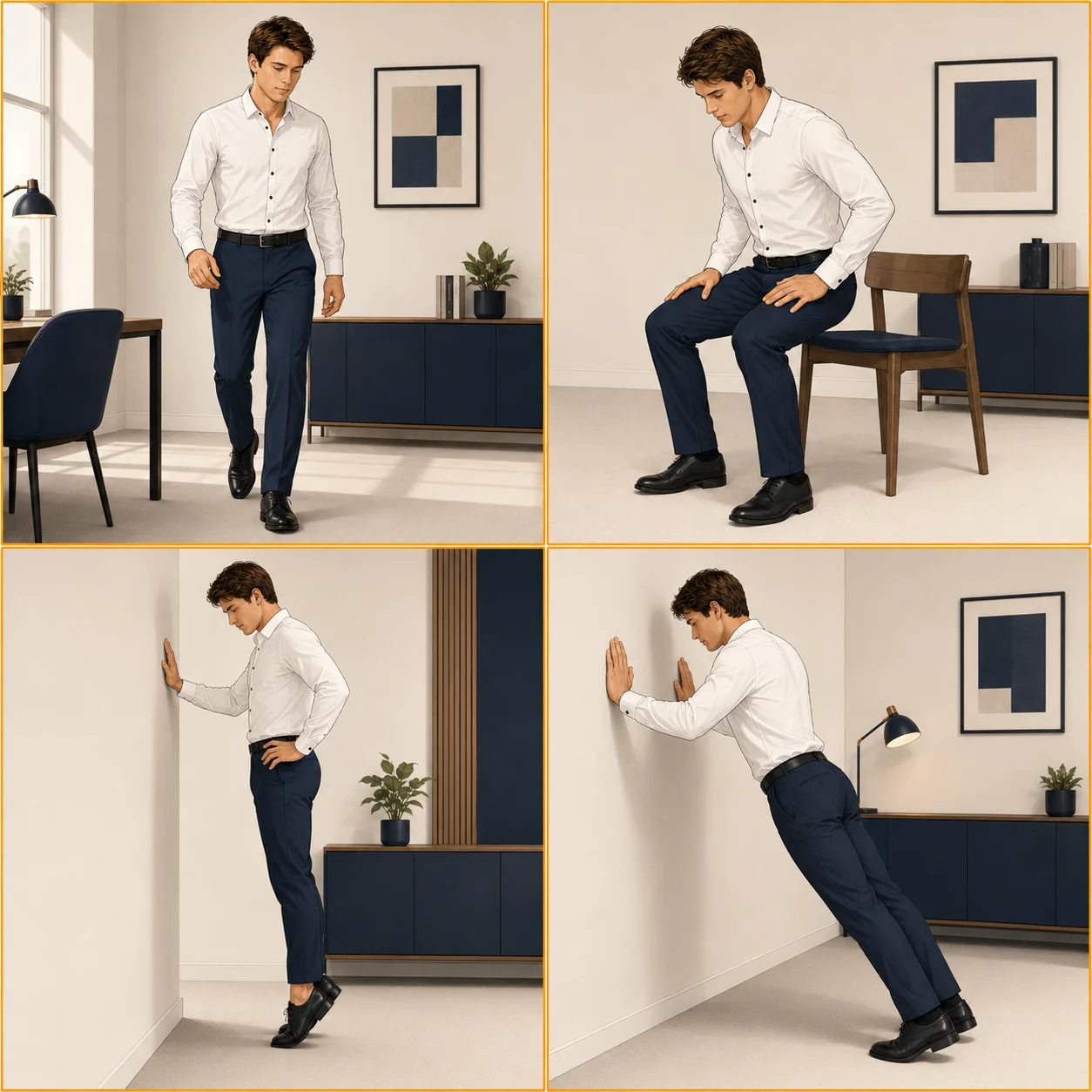
- The two-minute walk. Stand and walk for two minutes — room, hallway, building, anywhere. Don’t make it dramatic or count steps. Just move. The easiest starting option for almost everyone.
- Chair squats. Stand in front of your chair, push your hips back, lower slowly toward the seat, stand again. Start with five. The chair is your target and your safety net. Good for waking up the legs and hips.
- Calf raises. Near your desk or a wall, rise onto your toes and lower slowly, ten times. Quiet and space-friendly — ideal when you can’t leave the room.
- Wall push-ups. Hands on the wall, step back slightly, bend the elbows, push away. Gives the upper body a signal without the floor, equipment, or gym clothes.
- Stairs. Only if they’re safe for you. Start with one short flight at a controlled pace. Stairs are more intense than they look, so they’re not the best first option for everyone.
- Standing mobility reset. Stand, reach overhead, roll the shoulders, gently rotate the upper back, take two slow breaths. Not a fitness test — a posture and attention reset. Some days that’s exactly what you need.
Triggers beat motivation
Motivation is unreliable. A trigger isn’t. The trick to making a snack stick is to attach it to something that already happens in your day:
- After I finish lunch, I walk for two minutes.
- After my first long meeting, I do five chair squats.
- Before my afternoon coffee, I do ten calf raises.
- After I close my laptop, I do a standing reset.
A trigger is stronger than willpower because it borrows momentum from a habit you already have. Don’t start with a complicated schedule — start with one trigger. Once it feels automatic, add a second. For how often short breaks are worth taking and the timing behind it, the cadence research lives in The Science of Two-Minute Movement Breaks.
A simple 2-minute action
For the days you don’t want to think:

- Minute 1: walk around the room or hallway.
- Minute 2: five slow chair squats, then ten calf raises.
- Finish: two slow breaths.
That’s it. Don’t make it harder yet. The goal isn’t exhaustion — it’s repetition. A good snack should leave you a little more awake, not punished.
How to start safely
Match the movement to you, not your ego. Start easier than you think you need, choose movements you can control, and skip vigorous stairs or running in place until you’re ready. A reasonable first week: days 1–3, one two-minute walk after lunch; days 4–7, add five chair squats; week 2, repeat once or twice a day if it feels good.
Stop if any movement causes sharp pain, dizziness, chest discomfort, unusual shortness of breath, numbness, tingling, or anything that feels wrong. If you have a medical condition, a recent injury, balance or cardiovascular concerns, or persistent pain, get guidance from a qualified health professional before increasing activity. LibraryFit is educational, not medical advice.
Common mistakes
- Turning the snack into a workout too soon. The point is a repeatable interruption, not proof of toughness. If snack one makes you dread snack two, it’s too hard.
- Choosing movements that feel awkward at work. A movement can be effective but socially unrealistic. At home, chair squats are fine; in a shared office, a quiet walk or calf raises may fit better. The best routine is the one that survives real life.
- Waiting for a long break. You don’t need one — that’s the whole point. Use the gaps you already have: the minute after a meeting, the pause after sending an email.
- Thinking small movement doesn’t count. It counts when it changes the pattern. One walk won’t transform your health, but repeated breaks make a sitting-heavy day less still and less passive. That matters.
FAQ
What are exercise snacks? Short bouts of intentional movement spread through the day — walking, chair squats, wall push-ups, calf raises, stairs, or a quick mobility reset.
How long should one be? Usually one to five minutes. Beginners can start with one or two. The best length is the one you’ll repeat.
Do exercise snacks replace the gym? No. They can complement structured exercise, but they don’t replace longer walks, strength training, or regular cardio.
Can they help with weight loss? The evidence doesn’t support that. One review found no significant change in body weight or body fat, even though some fitness and cholesterol markers improved. Treat them as a way to move more, not a weight-loss method.
What’s the easiest one to start with? A two-minute walk — familiar, adjustable, no equipment.
Are stair-climbing snacks better? Not necessarily. Stairs were well received in a small workplace study, but they can be too intense for some people. Start gentler before choosing stairs.
Can exercise snacks improve focus? Early pilot evidence suggests they might, but it’s preliminary. Don’t rely on them as a guaranteed focus tool.
Are they safe for everyone? No single movement is automatically safe for everyone. Match the movement to your ability and check with a professional if you have health concerns, pain, injury, dizziness, balance issues, or cardiovascular symptoms.
The takeaway
Exercise snacks aren’t a shortcut. They’re a starting point. They help busy people stop waiting for the perfect workout window and begin with something small and real.
Stand up. Move for two minutes. Use your legs. Interrupt the pattern. Then repeat tomorrow. For people who sit too much, the first win isn’t becoming an athlete — it’s refusing to let the chair run the entire day. Small movement isn’t everything. But repeated, it’s far from nothing.
Want the full system?
This article gives you one tool: exercise snacks. A sitting-heavy life usually needs more than one. Desk Athlete Reset was built for people who sit too much and don’t want a complicated fitness identity — five minutes to interrupt the workday pattern, twelve to restore posture and breathing, thirty to build simple no-gym strength. Simple movement. Real research. No gym required.
Keep reading
- For why breaking up sitting helps your body — the metabolic science and how often to do it — read The Science of Two-Minute Movement Breaks.
- If sitting leaves your neck and shoulders stiff, read Why Your Neck Hurts After Computer Work.
- For the bigger picture behind all of this, read Sitting Is Not the Enemy — Uninterrupted Sitting Is.
Sources
- Alexe DI, Saha S, Choudhary PK, et al. (2025). Exercise snacks as a strategy to interrupt sedentary behavior: a systematic review of health outcomes and feasibility. Healthcare, 13, 3216. doi:10.3390/healthcare13243216
- Wan K-W, Dai Z-H, Wong P-S, et al. (2025). Effects of exercise snacks on cardiometabolic health and body composition in adults: a systematic review and meta-analysis. Scandinavian Journal of Medicine & Science in Sports. doi:10.1111/sms.70114
- Stork MJ, Marcotte-Chénard A, Jung ME, Little JP. (2024). Exercise in the workplace: examining the receptivity of practical and time-efficient stair-climbing “exercise snacks.” Applied Physiology, Nutrition, and Metabolism, 49(1), 30–40. doi:10.1139/apnm-2023-0128
- Mues JP, Flohr S, Kurpiers N. (2025). The influence of workplace-integrated exercise snacks on cognitive performance in sedentary middle-aged adults — a randomized pilot study. Sports, 13(6), 186. doi:10.3390/sports13060186
FREE TOOLKIT
The Desk Athlete Toolkit
Six printable movement cards you can do right at your desk — no gym, no equipment. One card for every workday moment.
Get the free toolkit