
Written and edited by the LibraryFit editorial team. Last updated June 2026.
Long sitting is linked to less hip mobility — not because something is wrong with you, but because the body settles into the position it holds most.
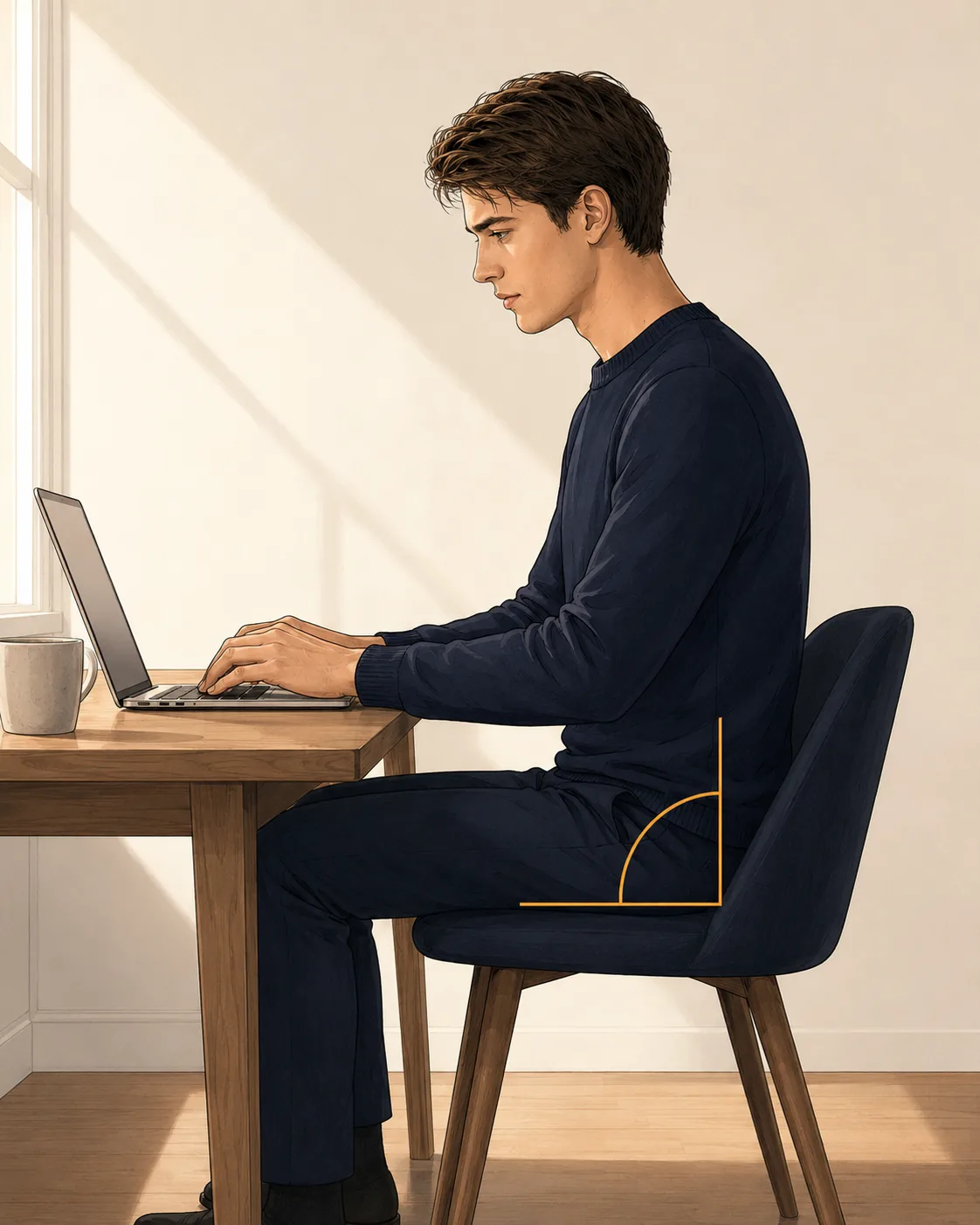
Most of the attention goes to the back. The chair, the posture, the screen height — all aimed at what is visible and adjustable. But somewhere in front of your hips, a group of muscles spends most of a desk day in a shortened position, held there by the simple geometry of sitting. They are not dramatic about it. No sharp signal, no clear complaint. Just hours of staying folded — and research suggests that pattern, repeated across working years, can leave a trace.
The question is not: “Do I have bad posture?” That question turns a structural situation into a personal failing. A better question is: “What is sitting actually doing to the front of my hips — and what is worth doing about it?”
That is what this article is about. Not blame. Just what the evidence shows, where it stops short, and one small thing you can do today.
What are hip flexors, and where do they sit in your day?
The hip flexors are a group of muscles running along the front of the pelvis and upper thighs. Their main job is to bring your knee toward your chest — which is exactly what happens, passively, the moment you sit down. The largest of them, the iliopsoas, connects the lower spine to the top of the thigh bone. It is one of the few muscles in the body that links the spine directly to the leg.
During a standard workday, this group spends most of its time in a shortened position. Not working hard — just held compressed, the way a spring looks when both ends are pushed together. The body, being efficient, tends to settle into the position it occupies most.
That settling is what the rest of this article looks at.
What does prolonged sitting do to these muscles?
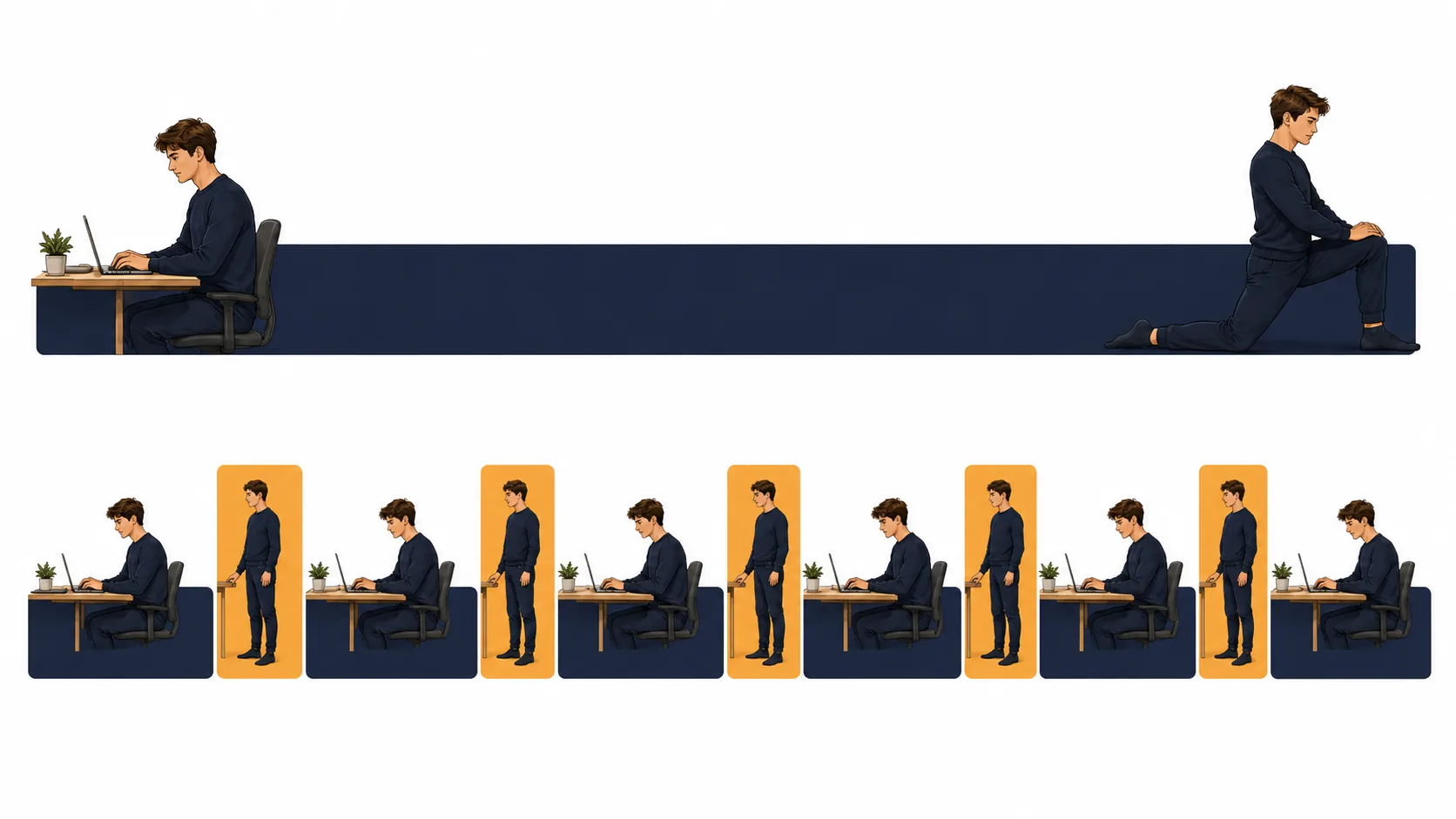
A cross-sectional study by Boukabache and colleagues (2021) measured passive hip extension — the ability to move the leg behind the body, which is the movement that asks the hip flexors to lengthen — across 98 adults. People who sat for long hours and moved little had measurably less passive hip extension than people who sat less and moved more: a difference of around six degrees between the two groups.
What causes that difference is not fully settled, and it is worth being honest about. It may reflect a change in the muscle’s resting length, or an increase in its stiffness — the muscle becoming less willing to lengthen rather than simply shorter. Either way, it is not injury. It is the body adapting to the position it spends the most time in.
The practical consequence is that ordinary movements — walking, standing, reaching the leg back — start to ask a little more from the muscles nearby to make up for what the front of the hip no longer does as easily.
This does not mean everyone who sits develops a clinical problem. It means the pattern is worth noticing before it becomes one.
Is tight hip flexors the reason your back hurts?
This question comes up often — and the honest answer is: possibly, but not always, and rarely on its own.
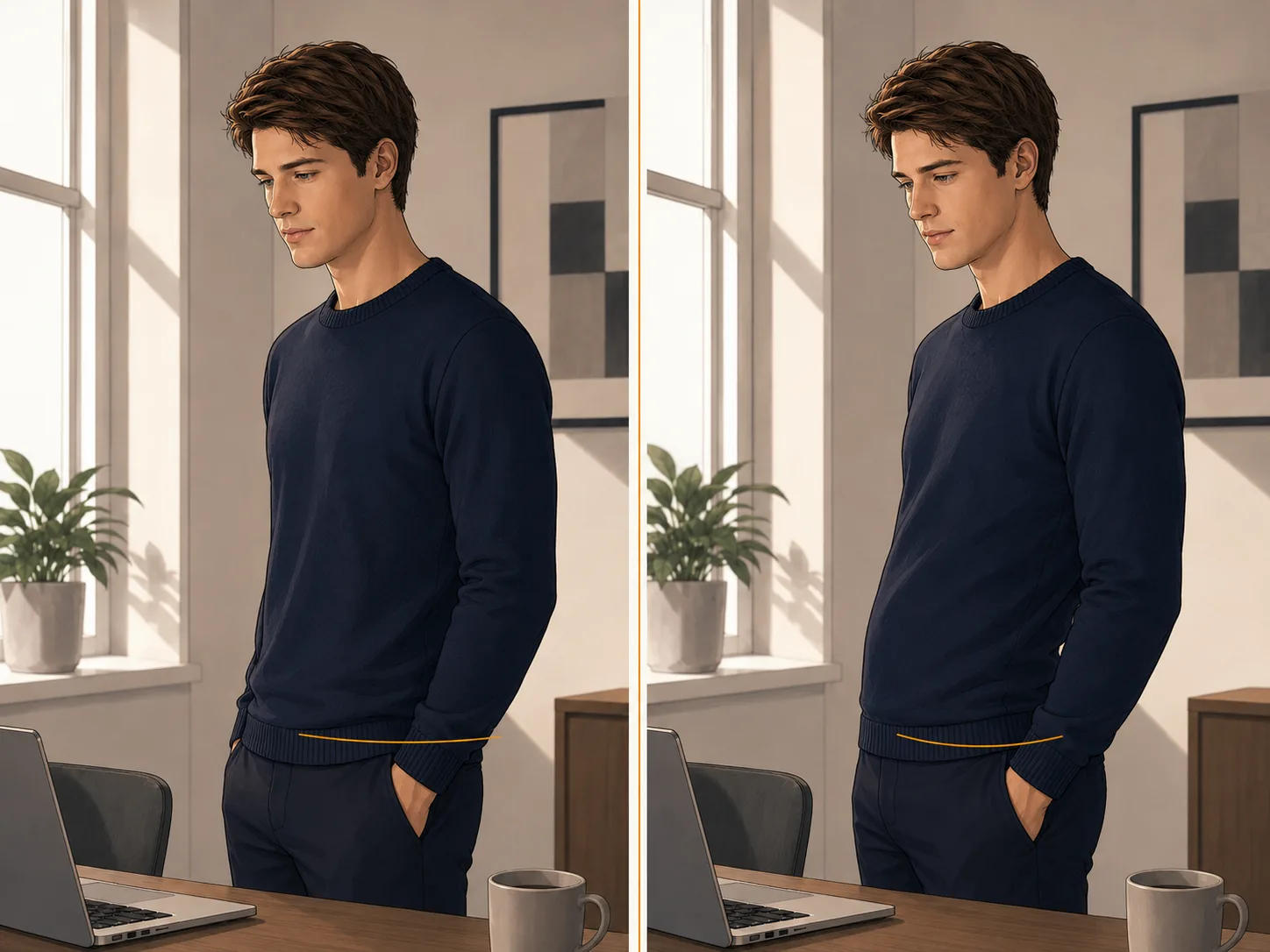
When the hip flexors stay shortened, they can tilt the pelvis forward, which increases the curve in the lower back. A 2024 study of desk workers by Singhvi and Bharnuke found that iliopsoas length was associated with the degree of that lower-back curve. Tightness in this muscle is one recognised part of the forward-tilt pattern that researchers connect to mechanical low back discomfort.
But that connection is associative, not causal. Tight hip flexors and back discomfort often appear together — which does not mean one is causing the other, or that addressing the hips alone will resolve it. If your back pain is persistent, significant, or comes with other symptoms, a physiotherapist or physician is the right starting point, not a stretching routine.
What the research does reasonably support is direction: easing habitual tension at the front of the hip, while keeping the muscles around it active, is a sensible part of a broader approach to desk-related back discomfort — not a cure for it. For the fuller back-pain picture, this article on desk-related back pain covers the wider anatomy.
What does research say about stretching hip flexors?
The front of the hip does respond to being lengthened regularly. In a 2025 study, healthy young adults who performed a daily hip flexor stretch improved both their hip flexor length and their gluteal power over the course of the program (Ehresman and colleagues). It was a small study in young, active people — not desk workers specifically — so it is a signal, not a guarantee. But it points somewhere useful: stretch the front of the hip consistently, and it tends to give.
The key word is consistently. One stretch does not undo months of sitting. Short, repeated stretching across weeks appears more useful than the occasional long session.
There is also a common worry that stretching makes you weaker. For the hip flexors specifically, that concern is mostly overstated. A 2021 systematic review by Konrad and colleagues found that stretching the hip flexors for up to two minutes had no meaningful negative effect on performance — only very long holds, several minutes at a time, produced a small dip. For a desk worker taking short stretch breaks, that means there is little downside to stretching during or after a sitting block.
One more thing the 2025 study quietly illustrates: lengthening the front of the hip and waking up the muscles behind it — the glutes — tend to travel together. Releasing tightness without giving the opposing muscles anything to do is less likely to hold. So the goal is not only to stretch, but to move.
One thing you can add to your workday — starting today
The question worth asking is not “how do I fix my hip flexors?” — it is “what can I do in the next hour that actually fits into my day?”
A standing hip flexor opener takes under two minutes, needs no equipment, and looks like little more than standing up and stepping back.
If you have pain, dizziness, a balance condition, or any health concern, keep movements within a comfortable range — or speak with a qualified professional before starting.
- Stand up and step one foot back into a short split stance, like a relaxed lunge.
- Tuck your tailbone slightly under and gently squeeze the glute on the back leg.
- Let the front of that back hip lengthen. You should feel a gentle stretch across the front of the hip and thigh — not in the knee or lower back.
- Hold for 20 to 30 seconds, breathe normally, then switch sides.
If you have a little space and don’t mind kneeling, the half-kneeling version pictured above targets the same muscle a touch more directly: one knee down, the other foot forward, tailbone tucked, weight shifting gently forward.
This is not a cure. It is a signal — a brief interruption of the position the front of your hip has been holding all day. Done consistently, that interruption is what the research suggests matters more than any single longer session. For more movement-break ideas built on the same idea, the two-minute sitting break article covers several options.
What this does not mean
It does not mean tight hip flexors are the source of everything uncomfortable in your lower body. The research links them to a pattern — not a diagnosis.
It does not mean stretching is always the answer. For some people the issue is not tightness at the front but weakness in the muscles behind. A movement professional can tell the difference, and it is worth asking rather than guessing.
It does not mean you need a long or complicated routine. Short, frequent interruptions tend to fit a real workday better than long, occasional sessions — and they are far easier to actually keep doing.
Takeaway
The hip flexors settle into a shorter, stiffer position in response to long sitting — not because something is wrong with you, but because the body adapts to the position it holds most. The research suggests that lengthening them regularly, and keeping the muscles around them active, can shift that pattern over time. The goal is not perfection. It is interruption — small, regular reminders that the body was built to move in more than one direction.
Want the full hip reset — not just one stretch?
This article gives you the reasoning and one stretch to begin with. The Desk Hip Reset is the complete version: every hip-opening movement from the simplest desk stretch to a deeper progression, the glute work that makes the change actually hold, and a simple 7-day plan to build the habit — all built on the same research you just read. A few minutes a day, no gym, no equipment.
Frequently Asked Questions
How do I know if my hip flexors are tight?
A common sign is stiffness or a pulling feeling at the front of the hip when you stand up after a long sitting block, or a noticeable forward tilt of the pelvis. A physiotherapist can confirm it with a simple assessment called the Thomas test.
How long does it take to improve hip flexor tightness?
There is no fixed timeline. What the research on stretching points to is consistency over weeks rather than single sessions — a short daily stretch tends to be more useful than an occasional long one. Single stretches give temporary relief, not lasting change.
Can I do the hip flexor stretch at my desk without anyone noticing?
Mostly, yes. A standing hip flexor opener looks a lot like simply standing and stepping one foot back — there is nothing conspicuous about it. The half-kneeling version is more noticeable, so it suits a home office or a private moment better.
Is yoga good for hip flexor tightness?
Low-lunge poses do lengthen the hip flexors directly, so yoga can be a reasonable addition to the simple stretch above. Treat it as a complement rather than a requirement — the goal is regular lengthening, by whatever route you will actually repeat.
What to Read Next
- Why Your Back Hurts Even With a Good Chair
- The 2-Minute Sitting Break: A Routine You’ll Actually Repeat
- Why Your Neck Hurts After Computer Work
- 5 Quiet Movement Breaks You Can Do in Work Clothes
Sources
- Boukabache A, Preece SJ, Brookes N. (2021). Prolonged sitting and physical inactivity are associated with limited hip extension: A cross-sectional study. Musculoskeletal Science and Practice, 51, 102282. doi:10.1016/j.msksp.2020.102282
- Singhvi PM, Bharnuke JK. (2024). A cross-sectional study on association of iliopsoas muscle length with lumbar lordosis among desk job workers. Indian Journal of Occupational and Environmental Medicine, 28(3), 235–238. doi:10.4103/ijoem.ijoem_316_23
- Konrad A, Močnik R, Titze S, Nakamura M, Tilp M. (2021). The influence of stretching the hip flexor muscles on performance parameters: A systematic review with meta-analysis. International Journal of Environmental Research and Public Health, 18(4), 1936. doi:10.3390/ijerph18041936
- Ehresman BA, et al. (2025). Improved hip flexibility and gluteal function following a daily lunge-and-reach stretching intervention. International Journal of Sports Physical Therapy, 20(6), 814–823. doi:10.26603/001c.137692
FREE TOOLKIT
The Desk Athlete Toolkit
Six printable movement cards you can do right at your desk — no gym, no equipment. One card for every workday moment.
Get the free toolkit