Written and edited by the LibraryFit editorial team. Last updated June 2026.
The sitting block is the pattern to interrupt — not sitting itself.
The question is not: “Do you move enough?”
That question carries too much guilt. It implies a character problem — that you lack discipline, motivation, or awareness. Most people who sit for long hours already know, somewhere in the background, that they are not moving enough. That awareness is not the missing piece.
A better question is: “What gets in the way — and what is the smallest thing that actually works?”
This article has two jobs. The first is to give you one short routine — two versions, depending on the day — that is specific enough to return to. The second is to show you how to build a reminder that does not feel like surveillance.
This does not mean two minutes will fix your health or reverse a long sitting day. It will not. What it can do is interrupt the sitting block before it extends into another hour you did not actively choose. For the science behind why long, uninterrupted sitting is worth interrupting, read The Science of Two-Minute Movement Breaks. For a broader menu of movements and how to start from zero, read Exercise Snacks for People With No Time.

Why you keep forgetting — and why that is not a character flaw
For many people, the issue is not laziness. It is not a lack of willpower. It is not that they forgot to care.
The issue is that desk work is designed around stillness. There is always one more email to answer, one more tab to open, one more message to send before stepping away. The work does not stop to offer a clear signal to stand up. So you do not stand up — not because you decided to stay seated, but because you never decided to leave.
That matters. It means the solution is not stronger motivation. It is a better system.
The two reasons sitting breaks stop working
Most sitting break habits collapse at one of two places — and both need to work at the same time.
The first is not knowing what to do. When a pause finally arrives in the workday, “go and move” is not a clear instruction. Without a specific sequence to return to, the moment closes, the next task opens, and the chair holds on for another hour.
The second is a reminder that creates friction instead of flow. A qualitative study by Cooley and colleagues spoke with six desk workers who had withdrawn from a workplace sitting-reduction programme. Some described the nudge-based reminders as feeling like monitoring. Others said the cues clashed with how their workplace expected them to behave.
This does not mean reminders do not work. This finding comes from a very specific group — six people who had already chosen to leave the study — and cannot be read as a general conclusion about all desk workers or all reminder types. What it points toward is something worth designing around: a cue that feels self-chosen tends to last longer than one that feels imposed.
This article addresses both problems. One routine. One principle for building a cue that fits real life.

What does the research actually say?
Most research on sitting breaks happens under controlled laboratory conditions that real offices do not resemble. A team at the University of Otago in New Zealand chose a different approach (Hargreaves and colleagues, 2021). They designed an intervention called Move More @ Work and tested it inside an actual office — asking employees to perform one to two minutes of physical activity after every thirty minutes of continuous sitting.
That is a specific, demanding target. And it was tested where the friction is real.
When the same team published their pilot outcomes two years later (Hargreaves and colleagues, 2023), the picture was more layered. Self-reported results were encouraging: participants reported following the programme 62 to 69 percent of the time, with self-reported improvement in physical activity, productivity, and musculoskeletal health at work.
Then the objective measurements arrived. Accelerometers — sensors that record what actually happens rather than what people remember — showed no meaningful change in the number of movement breaks taken. And the every-thirty-minutes target was found to be difficult to sustain in real office conditions.
What this means for you: starting with once every hour is not a lesser version of the right answer. It is the version the evidence actually supports. A break that happens hourly and consistently is more useful than a thirty-minute target that quietly collapses by midweek. Starting where your real day allows is not compromise. It is where the research points.
The 2-minute sitting break — two versions
A short movement break is not a workout. It is a signal — a brief, deliberate interruption that tells the body the workday is not allowed to hold it in one position for hours at a time.
Choose one version based on the day you are having.
If you have pain, dizziness, a balance condition, or any health concern, keep movements within a comfortable range — or speak with a qualified professional before starting.
Version 1 — The Standard Break
Use this on most days.
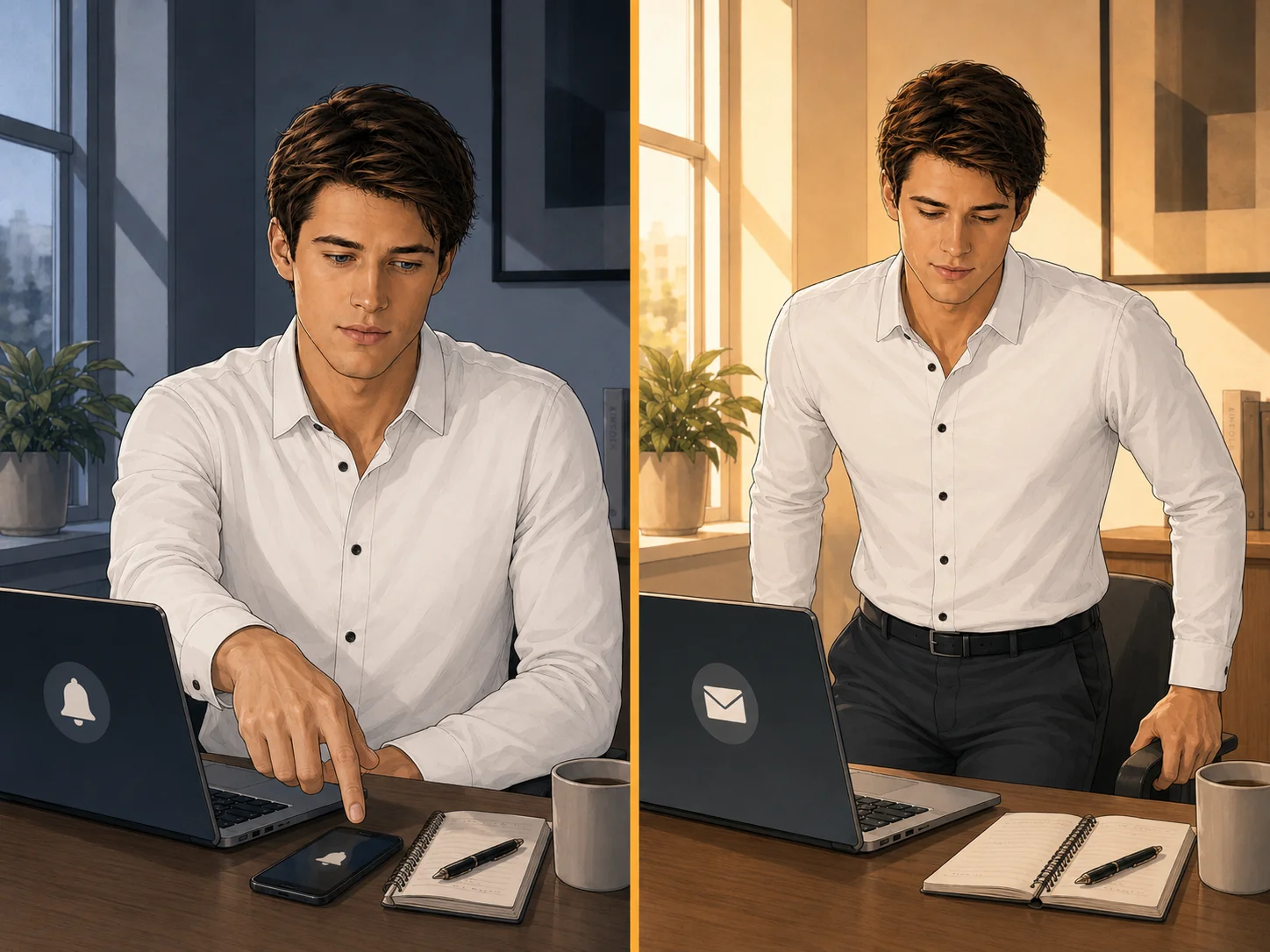
- Stand up. Let your feet settle on the floor. Do not correct anything yet.
- Walk somewhere — a window, a door, the kitchen, or simply around your desk.
- Reach both arms gently overhead, or rest both hands on your lower back and let your chest open slightly.
- Rise slowly onto your toes a few times, or march lightly in place for thirty seconds.
- Return to your desk and continue.
This is not exercise. It is a signal that your body is still part of the workday.
Version 2 — The Low-Energy Break
Use this on difficult days, low-energy afternoons, or whenever Version 1 feels like more than you can ask of yourself right now.
- Stand up. That alone is enough to begin.
- Shift your weight slowly from one foot to the other.
- Walk for thirty seconds in any direction.
- Take two slow breaths before sitting back down.
- Return to your desk.
This does not need to feel productive. It does not need to look like anything in particular. It simply needs to interrupt the sitting — and it does. And on days when even standing up is more than you can manage, how to move at your desk without standing up covers movements you can do without leaving the chair at all.
How to build a reminder that actually works
A reminder that fires mid-paragraph does not feel like an invitation. It feels like an interruption. Repeated enough times, it becomes something to dismiss. Repeated even more, it disappears into background noise entirely.
The goal is not a perfect reminder system. The goal is a cue that fits the shape of your actual day so naturally that following it is easier than ignoring it.
Event-based cues work better than random timers
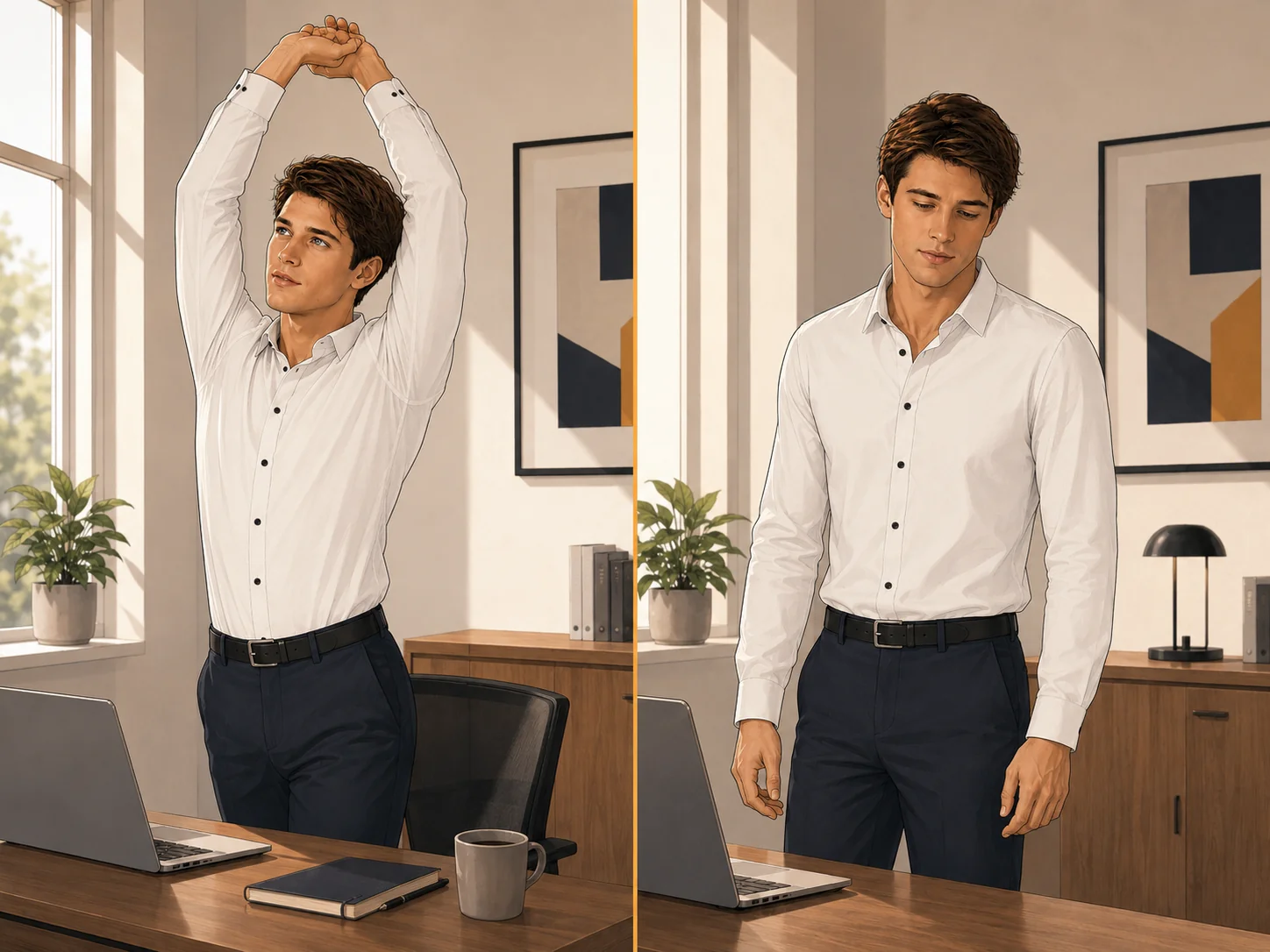
Rather than building a new trigger from scratch, attach the break to a moment that already exists. It can be:
- An important email sent — stand before opening the reply
- A meeting ending — walk before switching screens
- A water bottle emptied — go and refill it yourself
- A section of work finished — stand before starting the next
- A long focused session about to begin — stand first, not after
These do not require anything new. They attach to transitions that already arrive in your day.
One phrase is enough
If you want something visible, a small note on your monitor reading Break the block tends to work better than a generic alarm. It does not say “exercise.” It does not reference health targets. It says one thing: the sitting is running — stop it before another hour passes unnoticed.
That is a lighter ask than most reminders make. And lighter asks are the ones that survive the following week.
This does not mean you must give up timers. If a timer works for you, use it — but set it for forty-five to sixty minutes rather than thirty, and treat each alert as an option rather than an obligation. Miss one without penalty and simply wait for the next. There is no streak to protect here.
Will it help you focus?
This is one of the most common questions people bring to sitting breaks. It deserves an honest answer — not a confident one.
A randomised crossover trial by Chandran and colleagues placed twenty-one healthy adults through four hours of simulated office conditions across three sessions: uninterrupted sitting, sitting interrupted by three minutes of walking each hour, and sitting interrupted by three minutes of stair climbing each hour. Reaction time and accuracy declined more noticeably during the uninterrupted sitting condition than during either movement-break condition.
That is a useful finding. But it is a single laboratory study with twenty-one participants using simulated rather than real work tasks, and movement breaks of three minutes rather than two. It cannot be used to conclude that a short sitting break will reliably sharpen your concentration during a genuine workday.
A 2026 review by Freyer and colleagues examined how researchers have been measuring the effects of sitting breaks on cognitive performance across eighteen studies with 694 participants. Results varied widely. The review concluded that differences in study design, task types, and measurement approaches make strong conclusions difficult to reach.
The honest answer: a short sitting break may help you feel more alert after. Or it may simply stop the fatigue from deepening. Both are useful outcomes — and the current evidence does not reliably distinguish between them. Do not use the break because it promises better focus. Use it because it stops the sitting block from continuing past your awareness.
Common mistakes that make this harder than it needs to be
- Adding steps until the break becomes a routine to prepare for. A routine that requires preparation is easy to postpone. Two minutes is not the minimum. It is the design.
- Waiting until the body is already complaining. A break taken before the stiffness arrives is always easier than one taken after. Earlier is simpler.
- Using a reminder that creates irritation. A cue that creates small friction every time it fires will not survive the month. Replace it with a transition moment.
- Treating a missed break as a failure. You will miss breaks. That is expected, not exceptional. The goal is a consistent pattern, not a perfect streak.
- Expecting the break to substitute for exercise. A sitting break is a floor, not a ceiling. It interrupts stillness. It does not replace the physical activity that builds fitness or strength.
Try this once today
Do not try to change the whole day. Start here.
- Identify one moment already in your next work block — an email sent, a meeting ending, a water bottle emptied.
- When that moment arrives: stand up.
- Walk somewhere for thirty seconds.
- Take one slow breath.
- Return to your desk and continue.
This is not a new habit yet. It is a signal — a single, deliberate pause that says the sitting block does not get to continue without permission. If it happens once today, the pattern has already begun to shift.

The takeaway
The sitting block is the pattern to interrupt — not sitting itself.
A two-minute break does not need to be impressive to be useful. It needs to happen. Start with one. Build from there.
Want the full system?
This article gives you one routine and one principle. If you want a complete daily system that turns small resets into repeatable movement, Desk Athlete Reset is built for exactly that — no gym, no special equipment, no perfect streak required. Simple movement. Real research. No gym required.
FAQ
Is a 2-minute sitting break actually enough? For interrupting a sitting block — yes. For replacing regular exercise — no. These are different jobs, and this break is built for the first one only.
How often should I take a sitting break? Start with once every hour. Research that tested the every-thirty-minutes target in a real office found it difficult to sustain in practice. An hourly break is a more realistic starting point.
What should I do during the break? Stand up, walk briefly, move gently, and return. Version 1 works on most days. Version 2 is for low-energy moments. The exact movements matter less than leaving the chair.
Does a sitting break replace exercise? No. A sitting break interrupts stillness during a desk day. It does not replace the physical activity that builds fitness or strength over time.
How do I remember to take a break without feeling monitored? Attach it to a moment already in your day — an email sent, a meeting ending, a water bottle emptied. A cue that fits your existing rhythm tends to outlast one that fires independently of it.
Can I do this with back pain or a health condition? Keep movements within a range that is comfortable and pain-free. If you have a health condition or persistent discomfort, check with a qualified professional before starting.
Keep reading
- For the science behind why uninterrupted sitting is worth interrupting, read The Science of Two-Minute Movement Breaks.
- For a broader menu of movements and how to start from zero, read Exercise Snacks for People With No Time.
- For quiet movement breaks you can do in work clothes, read 5 Quiet Movement Breaks You Can Do in Work Clothes.
- For the broader research picture on sedentary behaviour itself, read what research says about sedentary behaviour.
Sources
- Hargreaves EA, Haszard JJ, Shaw S, Peddie MC. (2021). Protocol for a pilot trial to assess the feasibility of the Move More @ Work intervention to encourage employees to take the opportunity to move after every 30 min of sitting. Pilot and Feasibility Studies, 7, 172. doi:10.1186/s40814-021-00903-2
- Hargreaves EA, Shaw S, Scott T, Calverley J, Peddie MC. (2023). Feasibility and pilot outcomes of the Move More @ Work intervention designed to encourage employees to be physically active for 2 minutes after every 30 minutes of sitting. Journal of Occupational & Environmental Medicine, 65(11), 905–917. doi:10.1097/JOM.0000000000002920
- Chandran O, Shruthi P, Sukumar S, Kadavigere R, Chakravarthy K, Rao CR, Chandrasekaran B. (2023). Effects of physical activity breaks during prolonged sitting on vascular and executive function — a randomised cross-over trial. Journal of Taibah University Medical Sciences, 18(5), 1065–1075. doi:10.1016/j.jtumed.2023.03.004
- Freyer M, Jost C, Jankowiak S, Bressem K-A, Hegewald J. (2026). Evaluating the methods used to examine sitting breaks and their influence on mental load, physical strain, and cognitive performance — a scoping review. Frontiers in Physiology, 17, 1755356. doi:10.3389/fphys.2026.1755356
- Cooley PD, Mainsbridge CP, Cruickshank V, Guan H, Ye A, Pedersen SJ. (2022). Peer champions responses to nudge-based strategies designed to reduce prolonged sitting behaviour: lessons learnt and implications from lived experiences of non-compliant participants. AIMS Public Health, 9(3), 574–588. doi:10.3934/publichealth.2022040
FREE TOOLKIT
The Desk Athlete Toolkit
Six printable movement cards you can do right at your desk — no gym, no equipment. One card for every workday moment.
Get the free toolkit