
Written and edited by the LibraryFit editorial team. Last updated June 2026.
The research supports reducing long, uninterrupted sitting. It does not require a perfect number of hours to act on.
The question most people bring to this topic is some version of: “Is sitting bad for me?”
It is a reasonable question. But it is also the wrong one — because it leads toward a binary answer that does not match what the research actually shows.
A better question is: “What kind of sitting pattern is worth paying attention to — and what does the evidence say about it, honestly?”
This article has two jobs. The first is to explain what researchers mean when they use the term “sedentary behavior” — which is more precise than it sounds, and more useful once you understand the distinction. The second is to give you an honest picture of what the evidence shows, including where it stops short of giving clear answers. For the practical side — what to do, how to interrupt long sitting, and which movements to try — The 2-Minute Sitting Break, Exercise Snacks for People With No Time, and The Science of Two-Minute Movement Breaks are where those answers live.

What does “sedentary behavior” actually mean?
When researchers study sedentary behavior, they use a specific definition — one that is more precise than the everyday phrase “sitting too much,” and more useful once you understand what it includes.
The Sedentary Behavior Research Network formalized this definition after a structured consultation process involving researchers across multiple disciplines (Tremblay and colleagues, 2017). Sedentary behavior refers to any waking activity — not sleep — during which the body is in a seated, reclined, or lying position and expending very low levels of energy. The technical threshold is energy expenditure at or below 1.5 metabolic equivalents.
Two parts of that definition are worth pausing on.
First: it applies only to waking hours. Sleep is excluded entirely. The conversation about sedentary behavior is specifically about what the body is doing while you are alert and awake.
Second: posture and energy output together define the behavior. Sitting upright while cycling does not qualify. Reclining while watching television does. The low-energy waking posture is the defining feature — not any single activity in isolation.
Why it is not the same as “not exercising”
This distinction carries more weight than it might first seem — because many people treat sedentary behavior and physical inactivity as the same problem. They are not.
Physical inactivity, in research terms, means not meeting recommended levels of moderate or vigorous physical activity — typically around 150 minutes per week for adults. Sedentary behavior is something separate: the accumulation of low-energy waking time in sitting or reclining positions, independent of whether a person also exercises.
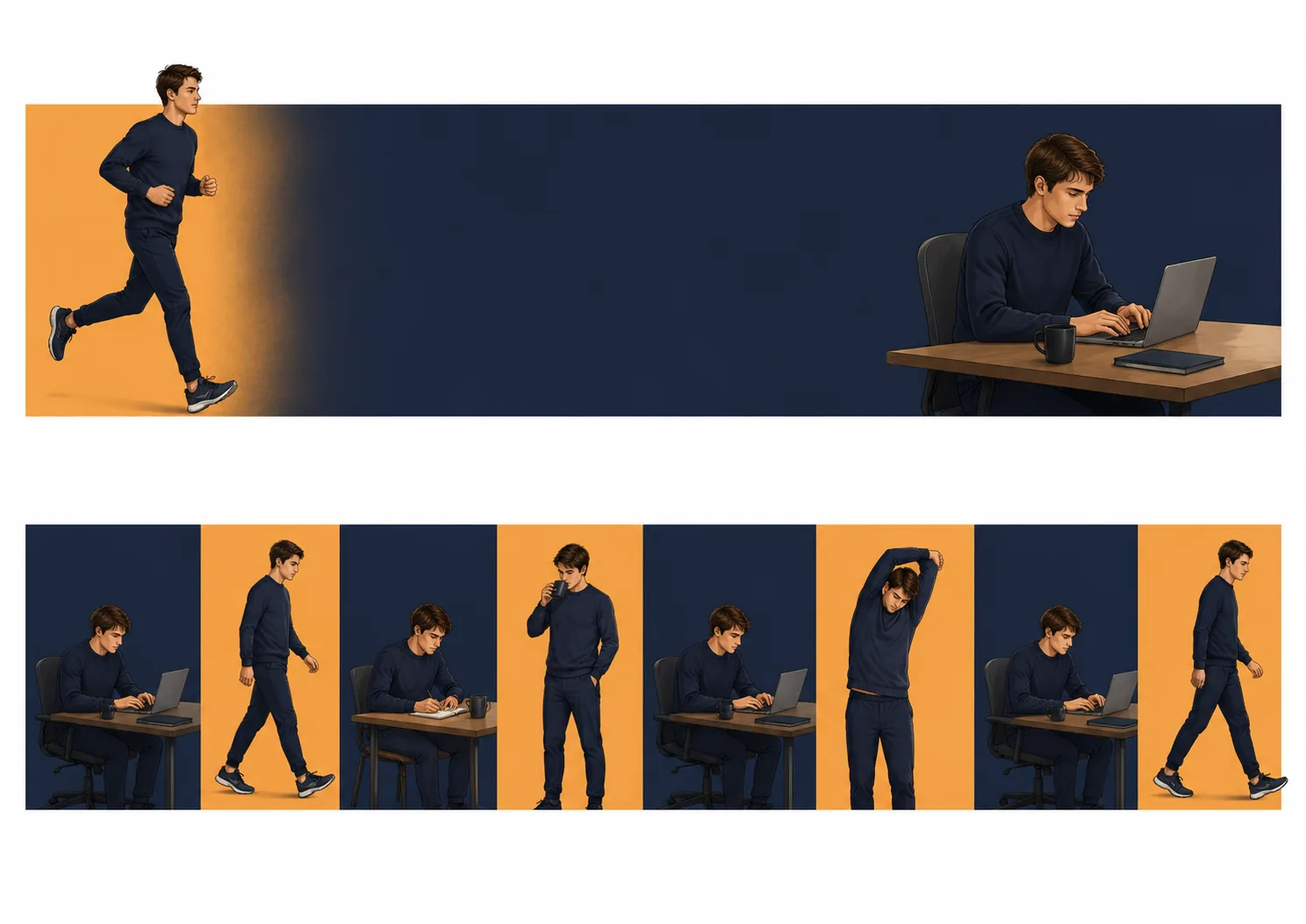
A person can meet exercise recommendations and still accumulate many hours of sedentary behavior across a workday. An early-morning run does not transform an eight-hour desk session into an active one, from a movement-pattern perspective. Equally, someone who rarely exercises formally but walks often, stands regularly, and rarely stays seated for long stretches uninterrupted may have a meaningfully different daily pattern.
For desk workers, students, drivers, and remote workers, that distinction has a practical consequence: sitting to work is not a character flaw. It is often the default structure of the day. The question worth asking is what can shift within that structure — not whether the structure itself represents a personal failing.
What does research link sedentary behavior to?
An overview of eighteen systematic reviews by Saunders and colleagues (2020) examined the relationship between different patterns of sedentary behavior and a range of health outcomes in adults. The breadth of that review makes it a useful reference point for understanding what the broader research landscape looks like in one place.
Across those eighteen reviews, high levels of sedentary behavior were found to be unfavorably associated with several outcome areas. These included cognitive function, depressive symptoms, physical function and disability, and health-related quality of life. The review also found that reducing or interrupting sedentary behavior may be linked with small improvements in body composition and some cardiometabolic markers.
The honest note on what “linked” means
When research describes sedentary behavior as “linked” or “associated” with less favorable outcomes, that language is doing specific work. It means two things tend to appear together in the data — not that one is causing the other.
Health is shaped by many overlapping factors: how someone sleeps, what they eat, the demands of their work, their medical history, their age, the structure of their environment, and much more. Sedentary behavior is one thread in that picture, not the full explanation for any outcome.
This does not mean the associations are without value. Repeated findings across multiple research teams and populations carry genuine weight, even without proof of direct causation. The honest framing is: high levels of sedentary behavior are consistently linked with less favorable patterns across several health areas — and that link is reason enough to pay attention, without requiring alarm.

Is there a safe daily sitting limit?
In 2020, the World Health Organization released updated guidelines on physical activity and sedentary behavior for adults — the first time it had provided population-level guidance specifically addressing sedentary behavior. The scientific evidence behind those guidelines was summarized in a companion paper by Dempsey and colleagues (2020).
The evidence review found moderate-certainty evidence linking higher sedentary behavior to a range of less favorable health outcomes, including all-cause mortality, cardiovascular disease, some cancers, and type 2 diabetes. That is a substantive finding — it places sedentary behavior within the scope of global public health priorities.
But the same evidence review was equally clear about what it could not support: setting a specific, quantified sitting-time limit for the general adult population. The data was insufficient to say “sit fewer than X hours per day and you are within a safe range.” The evidence was also insufficient to precisely define the optimal type, frequency, or duration of breaks from sitting.
What this actually means
This is the finding that most sitting-related content quietly passes over — and it may be the most practically useful one.
The absence of a universal time limit is not a gap in the science. It reflects the genuine complexity of how sedentary behavior interacts with everything else that shapes a person’s health. Someone who sleeps well, moves in other ways, and manages stress may experience the same sitting hours differently than someone whose overall movement pattern is very low across the board.
What the evidence does support — consistently — is the direction: reducing long, uninterrupted sedentary time and replacing some of it with movement appears to be a reasonable and evidence-informed target. The precise threshold is less important than the pattern.

Does reducing sitting actually change anything?
Most early research on sedentary behavior focused on observational studies — looking at what tends to appear alongside what. The more practically useful question is: when researchers have actually helped people sit less in real conditions, what happened?
A systematic review and meta-analysis by Hadgraft and colleagues (2021) examined this directly. The review analyzed 54 studies of adults in free-living conditions — real workplaces, homes, and daily environments, not controlled laboratory settings — where interventions aimed to reduce sedentary behavior, either on its own or combined with increases in physical activity. Studies were required to last at least seven days.
The findings showed evidence of small beneficial changes in some cardiometabolic biomarkers. These included measures of body weight, waist circumference, body fat percentage, systolic blood pressure, and some markers related to cholesterol and glucose metabolism.
Small is the operative word, and it belongs in any honest account of this evidence.
The review was equally clear about where the evidence runs out. High-quality studies — those with rigorous design, longer follow-up periods, and sensitive outcome measures — remain limited in this area. The review found insufficient evidence to draw conclusions about the effects of sedentary behavior reduction on inflammation or detailed vascular function.
The honest position: the evidence supports the direction. The precise magnitude of benefit remains an open question that ongoing research continues to address.
What does this mean for people who sit too much?
Taken together, these findings point in a consistent direction — without requiring any dramatic rearrangement of a workday to act on.
The definition matters because it removes the moral weight from sitting itself. Sitting is a posture and an energy state — not a verdict on how a person lives. It becomes worth addressing when it fills long stretches of waking time without interruption, not because it exists at all. That distinction — between sitting itself and uninterrupted sitting — is the foundation of Sitting Is Not the Enemy — Uninterrupted Sitting Is.
The research associations matter because they identify a genuine pattern worth paying attention to — in cognitive function, mood, physical capacity, and quality of life — without requiring that attention to tip into alarm or guilt.
The absence of a universal sitting limit matters because it removes the need to wait for a perfect number before making any change. The direction is clear. The exact formula is not fixed. That means any move toward less uninterrupted sitting is a genuine step, not a partial success measured against an ideal threshold.
And the intervention evidence matters because it shows that when change happens, it tends to produce real but modest shifts — not transformations, but measurable movement in the right direction.

The takeaway
Sedentary behavior is a pattern — not a verdict on how you live.
The research supports reducing long, uninterrupted sitting. It does not require a perfect number of hours to act on.
Start with one interruption. Build from there.
Want the full system?
This article gives you the evidence. If you want a practical daily system built on it, Desk Athlete Reset turns the research into a repeatable routine — no gym, no perfect schedule, no guilt required. Simple movement. Real research. No gym required.
FAQ
Is sedentary behavior the same as being physically inactive?
No — they describe different things. Physical inactivity means not meeting recommended activity levels. Sedentary behavior refers to low-energy waking time spent sitting, reclining, or lying down — regardless of whether you also exercise regularly.
Does research prove that sitting causes disease?
Not in that direct way. Research consistently links high sedentary behavior with less favorable health patterns across several areas, but most findings are associations — they show that two things tend to appear together, not that one causes the other.
Is there a safe number of hours I should sit each day?
Current evidence does not support a single universal sitting-time limit. The consistent direction across global guidelines is to reduce long uninterrupted sitting and replace some of it with movement — without specifying an exact daily threshold that applies to everyone.
Do movement breaks replace exercise?
No. Interrupting long sitting periods and meeting physical activity recommendations serve different purposes, and neither substitutes for the other. Both contribute to a fuller movement pattern.
What is the easiest first step?
Stand up after the next long sitting block and do one small movement before returning to work. The 2-Minute Sitting Break gives you a specific, repeatable routine to come back to.
Keep reading
- For the foundational argument — read Sitting Is Not the Enemy — Uninterrupted Sitting Is.
- For the science of how often to break sitting — read The Science of Two-Minute Movement Breaks.
- For movement that fits a packed day — read Exercise Snacks for People With No Time.
Sources
- Tremblay MS, Aubert S, Barnes JD, Saunders TJ, Carson V, Latimer-Cheung AE, Chastin SFM, Altenburg TM, Chinapaw MJM; SBRN Terminology Consensus Project Participants. (2017). Sedentary Behavior Research Network (SBRN) — Terminology Consensus Project process and outcome. International Journal of Behavioral Nutrition and Physical Activity, 14, 75. doi:10.1186/s12966-017-0525-8
- Saunders TJ, McIsaac T, Douillette K, Gaulton N, Hunter S, Rhodes RE, et al. (2020). Sedentary behaviour and health in adults: an overview of systematic reviews. Applied Physiology, Nutrition, and Metabolism, 45(10 Suppl 2), S197–S217. doi:10.1139/apnm-2020-0272
- Dempsey PC, Biddle SJH, Buman MP, Chastin S, Ekelund U, Friedenreich CM, et al. (2020). New global guidelines on sedentary behaviour and health for adults: broadening the behavioural targets. International Journal of Behavioral Nutrition and Physical Activity, 17, 151. doi:10.1186/s12966-020-01044-0
- Hadgraft NT, Winkler E, Climie RE, Grace MS, Romero L, Owen N, Dunstan D, Healy G, Dempsey PC. (2021). Effects of sedentary behaviour interventions on biomarkers of cardiometabolic risk in adults: systematic review with meta-analyses. British Journal of Sports Medicine, 55(3), 144–154. doi:10.1136/bjsports-2019-101154
FREE TOOLKIT
The Desk Athlete Toolkit
Six printable movement cards you can do right at your desk — no gym, no equipment. One card for every workday moment.
Get the free toolkit