
Written and edited by the LibraryFit editorial team. Last updated June 2026.
A practical guide to the desk-day pattern behind lower-back discomfort
You bought the better chair. You adjusted the lumbar support, set the seat height, and tried to “sit properly.” And still, by mid-afternoon, your lower back feels tight, tired, or irritated.
So here’s the honest question: if your chair is already good, why does your back still hurt after a long day at the desk?
In many cases the problem isn’t that the chair is bad. It’s that your body has been asked to stay too still for too long. A good chair can support sitting. It can’t replace movement. That one distinction changes everything about how you fix this.

The chair is not the whole system
A chair is only one part of your workday. Your back also responds to how long you sit, how often you change position, how you use your keyboard and screen, and whether your body gets any variation across the day.
A 2025 scoping review by Alaca and colleagues looked specifically at office workers and low back pain, pulling together evidence across many studies and thousands of participants. Longer sitting time, awkward posture, fewer breaks, and more static sitting all showed up alongside low back pain. The most useful finding for you: the pattern pointed more strongly to sitting behavior — how you sit, whether you break it up, how static you stay — than to clock-time alone. Some studies didn’t even find a clean link between hours sat and pain.
That’s the first key idea: your back doesn’t only care about the chair. It cares about the pattern. A perfect-looking seated posture held for hours can still get uncomfortable. A supportive chair used without breaks can still leave your spine, hips, and trunk muscles under steady low-level load. A good setup helps — it just can’t make your body immune to stillness.
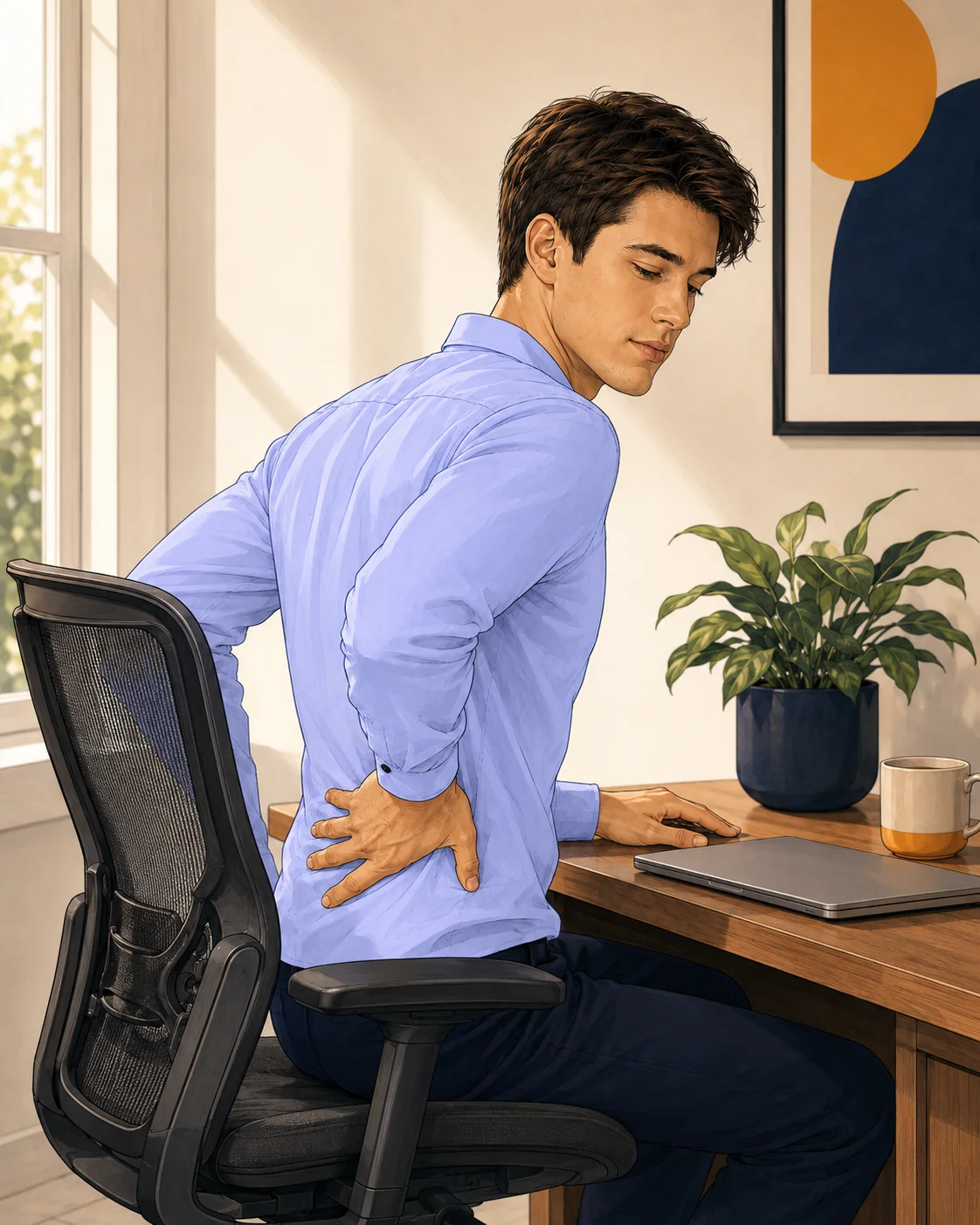
Why a good chair may still leave you sore
1. Your body wasn’t built for one fixed position. Sitting isn’t automatically harmful. The issue is uninterrupted, low-variation sitting. Stay in a narrow range of motion for long stretches and your spine, hips, and back muscles can stiffen, fatigue, and complain. The research is honest about not being able to say “sitting alone causes back pain in everyone” — but where it gets clearer is sitting behavior: breaks, position shifts, and how static you stay. So the better question isn’t only “how many hours did I sit?” It’s “how long did I hold one position before my body got to change?”
2. Your “good posture” can become its own stiffness. Many people try to fix back discomfort by locking into one “perfect” pose — shoulders back, chest up, spine straight, no slouching. That can help as a brief reset, but held for hours it just becomes another static position. There’s still no solid agreement that one ideal sitting posture exists or reliably prevents pain. The healthier goal isn’t a textbook freeze-frame — it’s a day with more posture options: upright sitting, relaxed supported sitting, brief standing, short walks, a little hip extension. The best posture is usually the next one.
3. Passive support isn’t the same as active recovery. A chair holds you up passively — useful, but different from moving. If your back has been still for 90 minutes, the answer probably isn’t another adjustment knob. It’s to stand, breathe, open the hips, walk, and come back in a different position.
A systematic review by Waongenngarm and colleagues looked at controlled trials of breaks in office workers, and the honest summary is this: the evidence that breaks reduce back pain on their own is weak and mixed, and the evidence they ease general discomfort is also limited. The one thing the review could say with reasonable confidence is that breaks don’t hurt your work output. And when the researchers separated break types, the active ones — where you actually change position — looked the most promising for pain and discomfort. So we won’t oversell breaks. But the active, position-changing kind is the version worth your time. A break isn’t a failure to work; a good one helps you return to it.
What the research really says about the chair
The honest answer isn’t the lazy “chairs don’t matter.” Chairs can matter. But the evidence also doesn’t support the idea that a chair alone fixes desk-related back pain.
A systematic review by Leyshon and colleagues looked specifically at ergonomic interventions for office workers who already have musculoskeletal problems. Its conclusion is worth sitting with: these products are marketed everywhere, but the research behind them is thin — none of the interventions had strong evidence, and most landed somewhere between “not enough evidence yet” and “moderate” at best. That protects you from a common trap: “I bought an ergonomic chair, so my back should be fixed.” Not necessarily. The chair may be helping — but the workday may still be too static, and the body may still need breaks, position changes, and a better daily rhythm.
The real problem: static sitting
The most useful idea here isn’t “sitting is bad.” It’s that static sitting is the problem. Static sitting means staying in one position with very little movement. You can be upright, using lumbar support, in an expensive chair — but if your body barely changes position, your back may still complain.
The same scoping review separates dynamic sitting (small shifts and movement while seated) from static sitting (prolonged fixed postures with minimal movement), and it’s the static version that tends to track with discomfort. That’s also why “active” furniture gets attention. A lab study by Kuster and colleagues on a dynamic office chair found that active sitting did engage the lumbar trunk muscles through a loading-and-unloading pattern as the seat moved — but it was a small lab study, and the authors were clear that more research is needed before we know how it plays out in a real workday.
So don’t treat dynamic chairs as a miracle. A dynamic chair, a standing desk, or a reminder app may help some people move more — but the principle is bigger than any product: your back usually wants variation, not another reason to stay still.
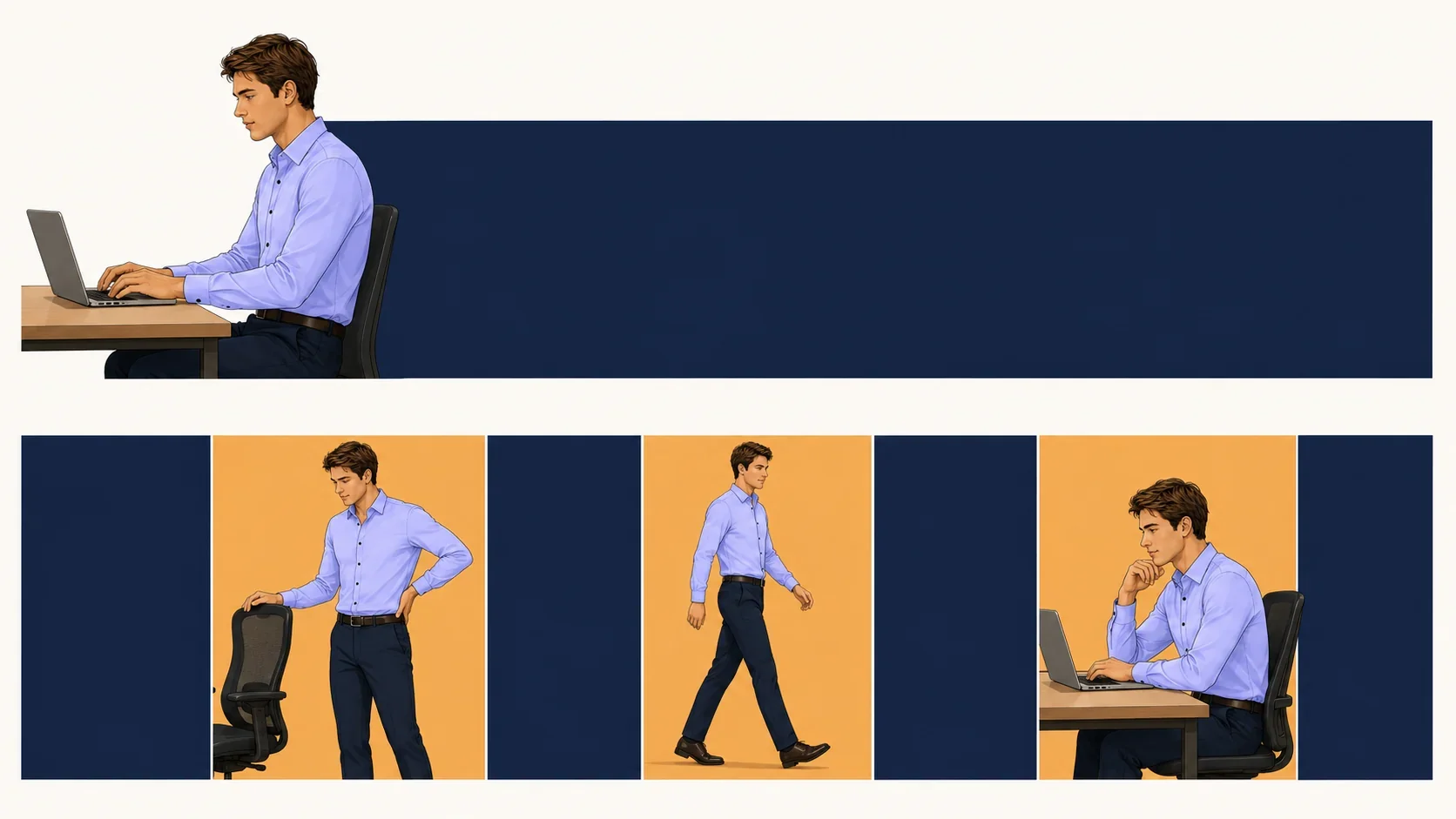
Why “just sit up straight” isn’t enough
Sitting upright can help, especially if you’ve been collapsing forward for hours. A study by Kuo and colleagues found that a wearable posture sensor helped people hold a more upright position during a one-hour typing task, with less forward-head and rounded-upper-back posture while the sensor was on.
But notice the limit: that was an immediate posture change during a controlled typing session. It doesn’t show that posture sensors prevent or treat long-term back pain — and the posture shifts themselves were small. So use the evidence honestly: posture awareness can help, feedback can remind you to adjust, but posture correction isn’t the whole answer. Someone who sits “perfectly” for three hours straight may feel worse than someone who sits reasonably, stands briefly, walks a minute, shifts their hips, and comes back refreshed. The bigger lever is movement variety.
Why this matters if you sit too much
Desk workers tend to hunt for one fix — a better chair, a standing desk, a lumbar cushion, a posture corrector, a stretch routine. Each can help in the right context, but none replaces the basic need for daily movement.
The stronger frame: your workspace should support movement, not trap you in one position. Your chair should be comfortable enough to support focus, but not so comfortable you forget to move. Your posture should be organized, but not rigid. Your breaks should be small enough to actually happen.
The takeaway
A good chair is useful, but it isn’t a complete back-care system. If your back hurts even with a good chair, don’t immediately assume you bought the wrong one. First, look at your sitting pattern:
- How long do I sit without standing?
- Do I change position, or stay frozen?
- Do I wait until pain shows up before I move?
- Do I use breaks as recovery, or only as escape?
The goal isn’t to hate sitting. It’s to make sitting less static. Sit well, move often, change before pain forces you to.
The 2-Minute Chair Reset
Use this when your back starts to feel heavy, stiff, or tired. It’s not a treatment — it’s a way to interrupt the seated pattern and give your body a different signal. Keep every movement gentle; if anything causes sharp or spreading pain, numbness, or dizziness, stop.
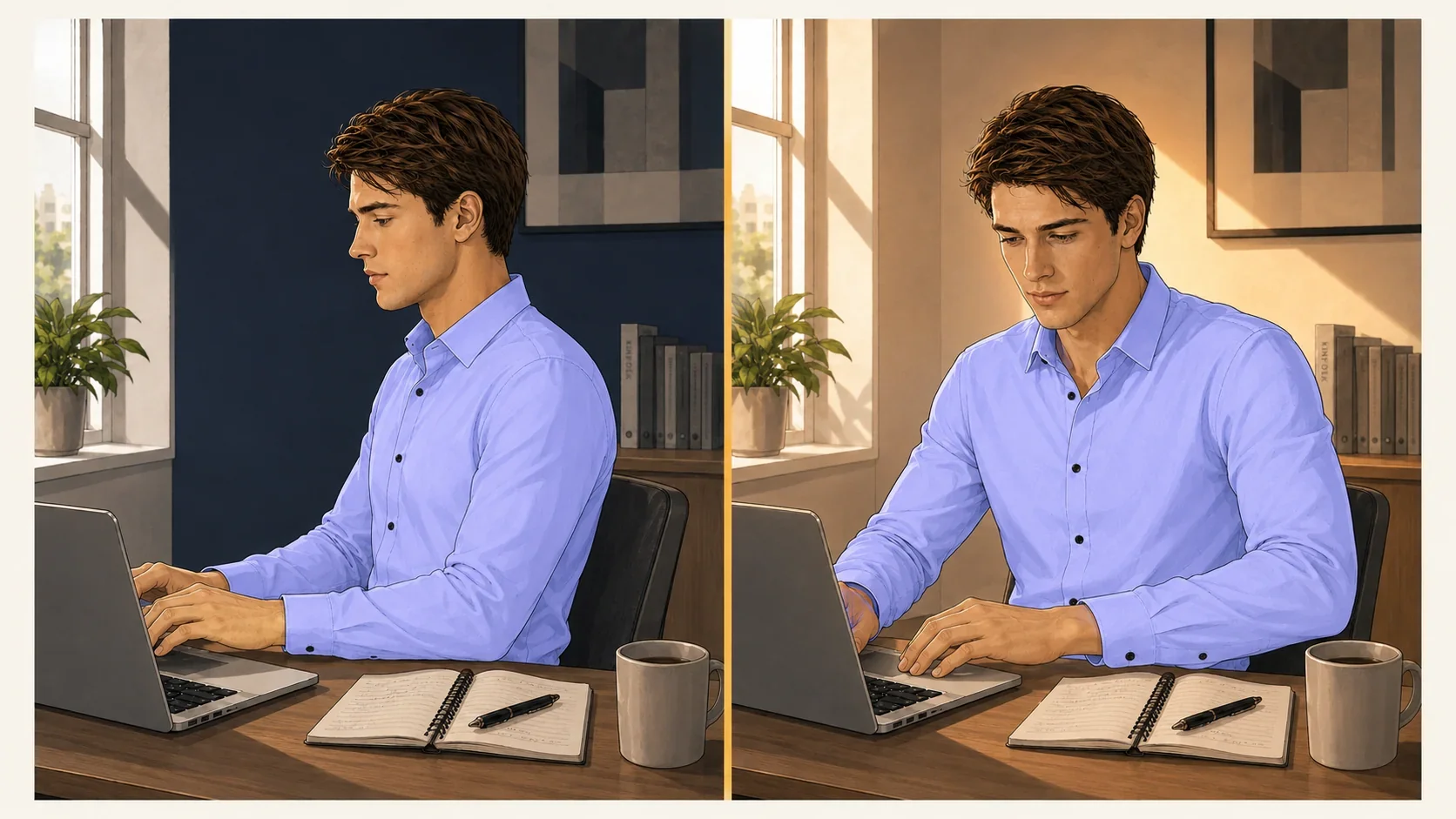
- Stand up slowly — 20 seconds. No rushing, no forced stretch. Let your feet settle under your hips.
- Stack your body — 20 seconds. Imagine ribs, shoulders, and head gently stacking over your pelvis. Relaxed, not military-stiff.
- Open the hips — 30 seconds. Hands lightly on your hips, step one foot slightly back and gently squeeze the back-leg glute. Switch sides. This gives your hips a break from the seated angle.
- Walk — 40 seconds. Around the room or hallway. Easy pace — the goal is circulation and position change, not exercise.
- Sit differently — 10 seconds. Return to the chair, but not to the exact same position. Adjust one thing: foot position, seat depth, back support, or screen distance.
Instead of telling your body “stay here,” you’re telling it “change is allowed.”
A simple workday rule
Every 30–45 minutes, change something. You don’t always need a full break — you can switch from sitting to standing, stand and breathe, walk for a minute, shift your chair, or do a quick hip reset. The break research uses a wide range of schedules, so there’s no perfect timer to chase. The goal is consistency: small movement repeated through the day beats one heroic stretch at 5 p.m. For more on how often short breaks are worth taking and the science behind them, see The Science of Two-Minute Movement Breaks.
What not to do
- Don’t keep buying chairs without changing your habits. New gear won’t fix a static day.
- Don’t lock into one rigid position all day. Variation matters more than any single “correct” pose.
- Don’t wait for pain to move you. Change position before your back starts asking.
- Don’t treat standing as magic. Standing still for too long gets uncomfortable too — the point is variety, not just being upright.
- Don’t ignore pain that’s severe, spreading, injury-related, or affecting daily life. That’s the line where you get a professional assessment, not another desk tweak.
FAQ
Is my chair causing my back pain?
It might contribute, especially if it’s poorly adjusted or doesn’t fit you. But a good chair doesn’t remove the need to move. Research points to sitting behavior — breaks and static sitting — as a big part of the picture for office workers.
Should I buy a more expensive ergonomic chair?
Not as your first move. Start with your sitting pattern, break habits, and setup. Ergonomic chairs may help some people, but the evidence isn’t strong enough to treat one as a guaranteed fix.
Is standing better than sitting?
Standing helps because it changes your position, but standing all day isn’t the goal. Aim for variation: sit, stand, walk, reset, return.
How often should I move?
There’s no perfect universal schedule. A practical start is to change position every 30–45 minutes. If your back already aches, you may want shorter, more frequent changes.
Are passive breaks enough?
Passive rest can feel nice, but the evidence leans more toward active breaks with a change of position for back pain and discomfort.
What if my back pain doesn’t improve?
If it’s persistent, severe, worsening, or affecting normal life, see a qualified health professional. This article is educational — not a diagnosis or treatment plan.
Want the full system?
If your workday regularly leaves you stiff, tired, and low on energy, you may want a fuller structure. Desk Athlete Reset was built for people who sit too much and don’t want a complicated fitness identity — five minutes to interrupt the pattern, twelve to restore posture and breathing, thirty to build simple no-gym strength. Simple movement. Real research. No gym required.
Keep reading
- If the stiffness is more in your neck and shoulders than your lower back, read Why Your Neck Hurts After Computer Work.
- For how often to break up sitting and the science behind it, read The Science of Two-Minute Movement Breaks.
- For the bigger picture, read Sitting Is Not the Enemy — Uninterrupted Sitting Is.
Sources
- Alaca N, Acar AÖ, Öztürk S. (2025). Low back pain and sitting time, posture and behavior in office workers: a scoping review. Journal of Back and Musculoskeletal Rehabilitation, 38(5), 919–943. doi:10.1177/10538127251320320
- Waongenngarm P, Areerak K, Janwantanakul P. (2018). The effects of breaks on low back pain, discomfort, and work productivity in office workers: a systematic review of randomized and non-randomized controlled trials. Applied Ergonomics, 68, 230–239. doi:10.1016/j.apergo.2017.12.003
- Leyshon R, Chalova K, Gerson L, Savtchenko A, Zakrzewski R, Howie A, Shaw L. (2010). Ergonomic interventions for office workers with musculoskeletal disorders: a systematic review. Work, 35(3), 335–348. doi:10.3233/WOR-2010-0994
- Kuo Y-L, Huang K-Y, Kao C-Y, Tsai Y-J. (2021). Sitting posture during prolonged computer typing with and without a wearable biofeedback sensor. International Journal of Environmental Research and Public Health, 18(10), 5430. doi:10.3390/ijerph18105430
- Kuster RP, Bauer CM, Baumgartner D. (2020). Is active sitting on a dynamic office chair controlled by the trunk muscles? PLoS One, 15(11), e0242854. doi:10.1371/journal.pone.0242854
FREE TOOLKIT
The Desk Athlete Toolkit
Six printable movement cards you can do right at your desk — no gym, no equipment. One card for every workday moment.
Get the free toolkit