
Written and edited by the LibraryFit editorial team. Last updated June 2026.
Working from home can make a full workday feel busy while your body barely moves.
You answer messages, join calls, finish tasks — and still end the day with fewer steps, longer sitting blocks, and that heavy “I’ve been stuck in one place” feeling.
That doesn’t mean you’re lazy, and it doesn’t mean working from home is bad. It means your home office may have quietly removed the small movement cues that used to happen on their own during an onsite workday. This article shows why that movement disappears for many desk-based workers — and how to add it back without turning your home into a gym. For why interrupting sitting matters at all, see Sitting Is Not the Enemy — Uninterrupted Sitting Is.
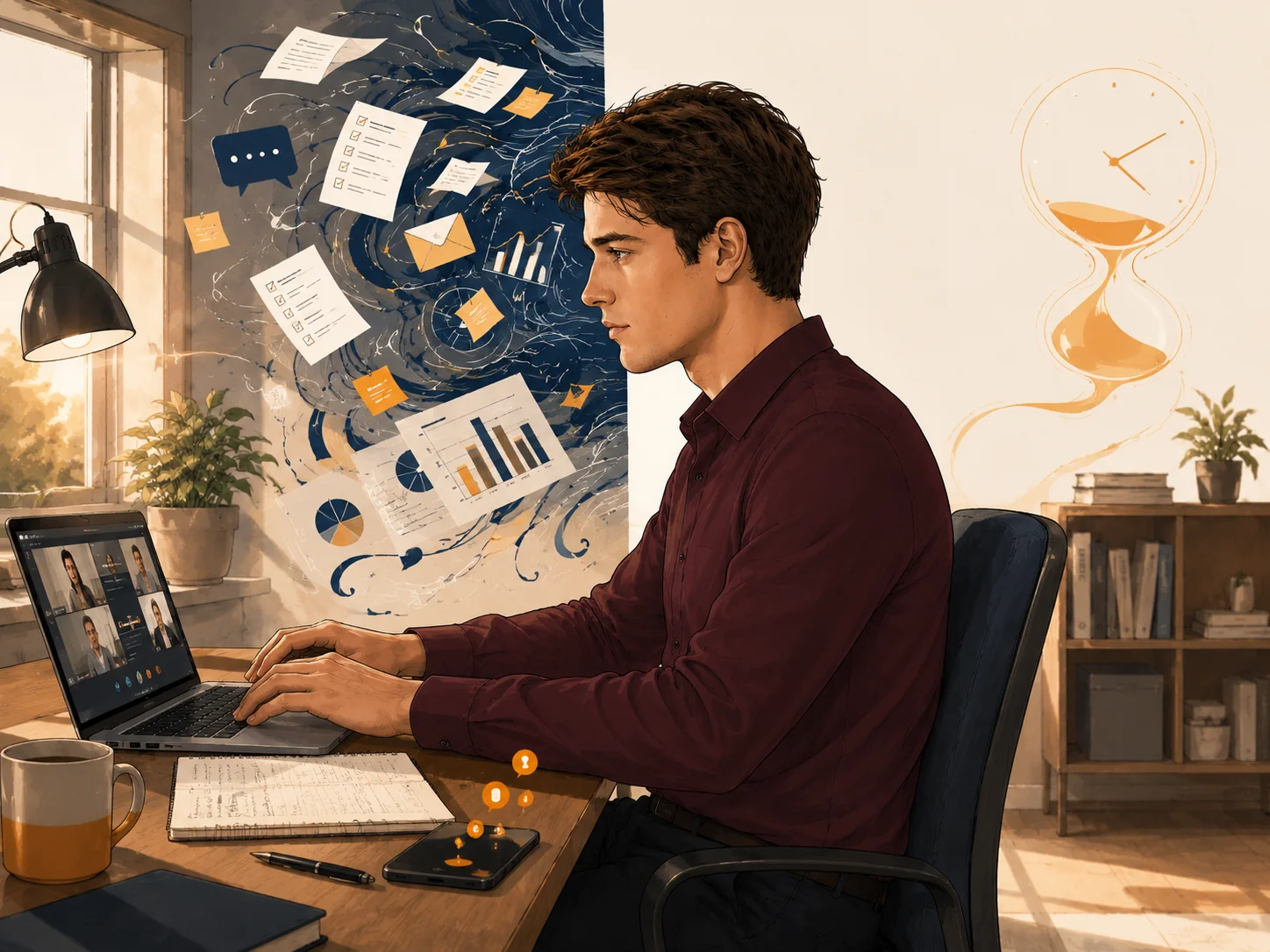
The real problem isn’t the chair
Most people blame the chair first. The chair can matter — but for many people working from home, the bigger issue is the shape of the day. Your body responds not just to how you sit, but to how often you change position, stand, walk, and break up long sitting blocks.
In an onsite workplace, some movement happens almost without planning. You arrive. You move through the building. You walk to a meeting room, the printer, the coffee area, a colleague’s desk. You stand during quick conversations. At home, the workday shrinks: the laptop is close, the drink is close, the phone is close, meetings happen through a screen, and the next task starts without standing up.
That’s the hidden issue — working from home can remove movement without making the day feel any less busy.
What the evidence shows
The safest message from the research is simple: for many desk-based workers, working from home is linked with more sitting and fewer steps.
A systematic review and meta-analysis by Schöne and colleagues compared working from home with onsite work across 38 studies and found a pattern of more sitting during work hours and fewer daily steps at home. The authors were careful, though: methods varied, and many studies came from the pandemic period, so this isn’t a fixed rule for every worker. The SITFLEX study (Sauter and colleagues) adds a real-world example, using activPAL3 movement sensors on desk-based hybrid workers — and again, working from home was linked with more sedentary time and fewer steps than the office.
So we shouldn’t say “working from home is unhealthy.” A more honest sentence is: working from home can make daily movement easier to lose — especially for desk-based workers who don’t deliberately build it back into the day.

The home office movement gap
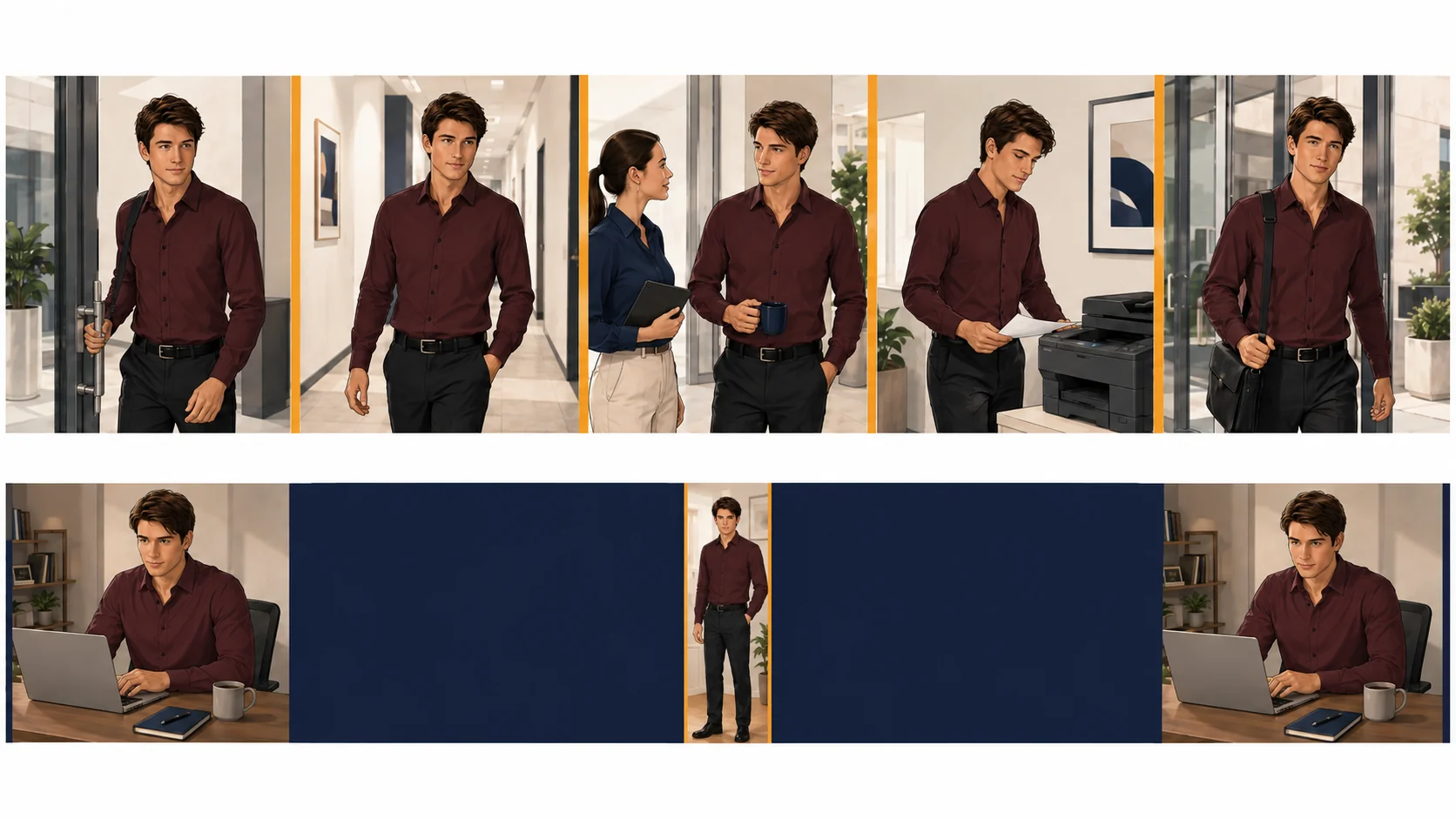
Think of an onsite workday and a home workday as two different movement maps.
Onsite, the day tends to include an arrival walk, walking between rooms, shared spaces, short standing conversations, small task transitions, and a walk out of the building at the end. At home, the map can shrink to: desk → screen → video call → nearby kitchen → nearby bathroom → back to desk.
This doesn’t make onsite work perfect — plenty of office workers sit too much too. But working from home can make movement far less automatic. That’s the key point for LibraryFit: don’t wait for movement to happen by accident. Build small movement cues into the day on purpose.
It’s not only a motivation problem
“Move more” is easy advice — and incomplete. Home-office sitting isn’t only about discipline.
Coffey and colleagues found that reducing sitting at home involves autonomy, organizational support, social support, trust, and accountability — and that some employees hesitate to leave the desk because they don’t feel fully trusted while working from home. Mott and colleagues, studying older desk-based employees, found that interrupting sitting at home is shaped by unclear knowledge, job demands, a lack of conscious action, and the fact that breaking up sitting often isn’t part of home-working culture. Researchers are responding to exactly this: Sivaramakrishnan and colleagues systematically developed a structured intervention to help home-based workers move more — designing the support rather than leaving it to willpower.
That matters. If the problem were only laziness, the fix would be “try harder.” But when the problem includes routine, work pressure, environment, habits, and culture, the better answer is to design movement back into the day rather than rely on willpower. The how-to of building movement habits — triggers, starting from zero — is covered in Exercise Snacks for People With No Time; here we focus on the cues unique to a home day.
How to add movement back into a home-office day
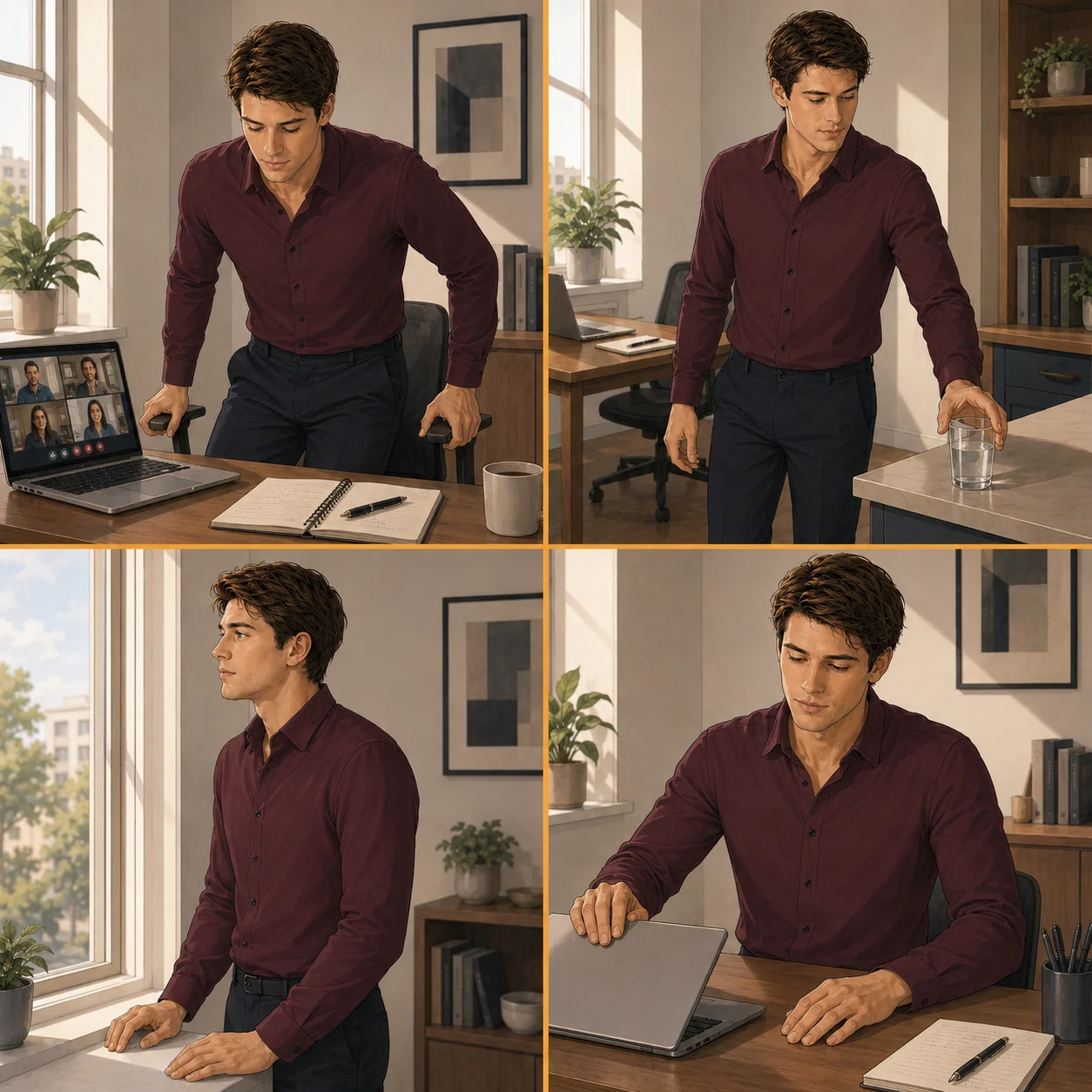
You don’t need a big plan. Use small cues that fit the day you already have — and these four are home-specific:
After calls
A video call already creates a natural stopping point. When one ends, stand before opening the next email, walk 30–60 seconds, look away from the screen, then return. It’s a pattern break, not a workout.
Water or coffee
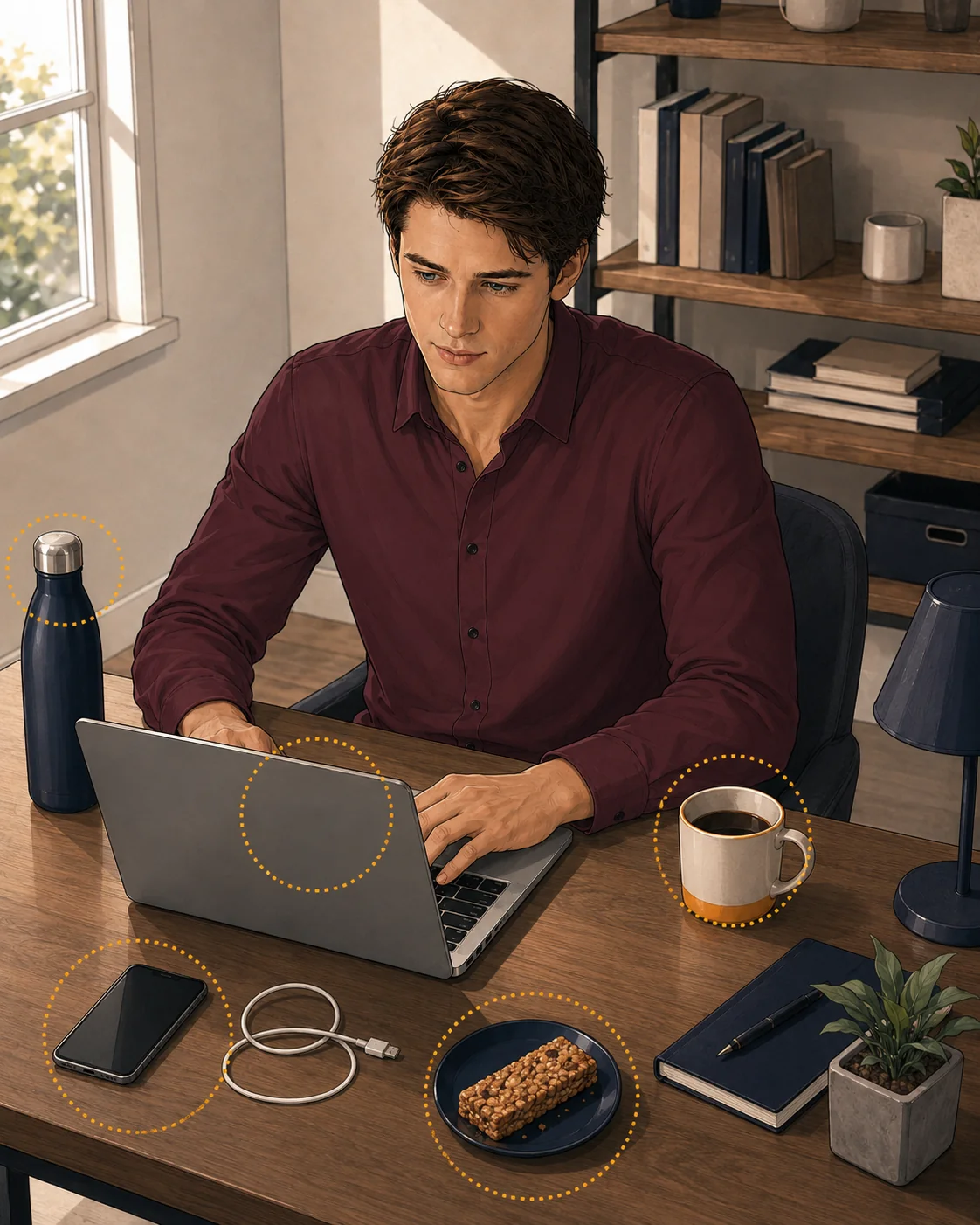
Don’t keep everything within arm’s reach. Put your water or refill point a few steps from the desk, so each refill becomes a small reason to stand and walk.
Before lunch
Walk for two minutes before lunch — inside is fine, outside is better. It puts a physical transition between screen work and food, and stops the morning from becoming one long sitting block.
End of the workday
Remote work blurs the end of the day. Build a short closing routine: stand, walk, tidy one item, step away. Think of it as a small replacement for the commute your body no longer gets.
These are a starting set, not a full program — keep it light. A plan that survives a normal workday beats a perfect plan you follow once.
A few honest cautions
- Don’t wait until your body complains. Interrupt the sitting earlier, not at 5 p.m.
- Don’t lean on motivation. Cues tied to things that already happen (calls, drinks, lunch, closing the laptop) are more reliable than willpower.
- Don’t keep everything too close. A convenient desk becomes a low-movement desk. Move one item slightly away.
- Don’t treat standing as the whole fix. Standing changes position, but standing still is just another stillness. Aim for variation: sit, stand, walk, reset, repeat.
- Don’t start too big. One cue, repeated for a week, then add another.
2-minute action
Try this today after one long sitting block: stand up, walk away from the desk, take three slow breaths, roll your shoulders gently, walk to another room and back — then, before sitting again, move one useful item slightly away from the desk. That last step matters: you’re not only taking one break, you’re setting up the next one.
The takeaway
Working from home can reduce daily movement because the home office makes sitting easier and walking less automatic. That doesn’t make remote work bad — it means the day needs better movement design. Start small: stand after calls, move your water away, walk before lunch, build a short end-of-day reset. Small movement counts when it’s repeated.
Want the full system?
These cues are a simple starting point. If you want a more complete way to build movement into long desk days, Desk Athlete Reset turns small resets into a repeatable daily routine — no gym, no special equipment, no dramatic lifestyle change. Start small. Repeat what works. Let movement become part of the workday instead of something you keep postponing. Simple movement. Real research. No gym required.
FAQ
Does working from home always reduce movement?
No. Some people move more at home. But the evidence shows a pattern: many desk-based workers sit more and take fewer steps at home than onsite.
Is a standing desk enough?
Not by itself. It can help with position change, but the bigger goal is movement variation — standing still all day isn’t the answer either.
How often should I move?
There’s no perfect rule. A practical start is to tie movement to normal transitions: after calls, before lunch, during refills, and at the end of the day.
Do small movement breaks count?
Yes — as repeatable signals that stop the day from becoming one long sitting block. Not magic, just consistent.
What’s the easiest first habit?
Stand and walk briefly after every video call. Simple, clear, and tied to something already in your schedule.
Keep reading
- For why interrupting sitting matters, read Sitting Is Not the Enemy — Uninterrupted Sitting Is.
- For how to build movement habits from zero, read Exercise Snacks for People With No Time.
- For the science of short breaks and how often to take them, read The Science of Two-Minute Movement Breaks.
Sources
- Schöne C, Sauter M, Backé E-M, Prigge M, Brendler C, Hegewald J. (2025). The impact of working from home on sedentary behaviour and physical activity compared to onsite work in the working population: a systematic review and meta-analysis. BMC Public Health, 25, 3963. doi:10.1186/s12889-025-24960-x
- Sauter M, Backé E-M, Pfab C, Prigge M, Brendler C, Liebers F, von Löwis P, Pfeiffer A, Papenfuss F, Hegewald J. (2025). Comparison of sedentary time, number of steps and sit-to-stand transitions of desk-based workers in different office environments including working from home (SITFLEX study). Scandinavian Journal of Work, Environment & Health, 51(4), 333–343. doi:10.5271/sjweh.4228
- Coffey A, Parés-Salomón I, Bort-Roig J, Proper KI, Walsh D, Reckman P, Vaqué-Crusellas C, Señé-Mir AM, Puig-Ribera AM, Dowd KP. (2025). Factors influencing reducing sedentary time in home office employees. Scientific Reports, 15, 24147. doi:10.1038/s41598-025-08831-4
- Sivaramakrishnan D, Fitzsimons C, Morton S, Manner J, Jepson R, Niven A. (2025). Are we working (too) comfortably? The systematic development of an intervention to support workers to move more while working at home. International Journal of Behavioral Nutrition and Physical Activity, 22, 84. doi:10.1186/s12966-025-01762-3
- Mott L, Parchment A, Money A, Johnson S, Todd C. (2026). Interrupting sedentary behaviour when working from home: a qualitative exploration of older desk-based employees. BMC Public Health, 26, 796. doi:10.1186/s12889-026-26719-4
FREE TOOLKIT
The Desk Athlete Toolkit
Six printable movement cards you can do right at your desk — no gym, no equipment. One card for every workday moment.
Get the free toolkit